Sunday, February 15, 2015

Jeff Chien-Hsing Liao at the Museum of the city of New York


                               Jeff Chien Hsing Liao’s - Flatiron Building, Manhattan
                               2010

When I walked into Liao’s at the Museum of the city of New York, I felt like I just entered an urban area. Most of the pictures were city views; however, I started noticing some special qualities to the images that aroused my interest. They didn’t look like Daido Moriyama’s traditional city pictures, but instead each picture has its own character and main focus, it’s obvious because a video in the exhibition unfolds this process. Many of his digital works were done with multiple exposures and focal points inside one frame. An image of the Flatiron Building caught my attention the most with the clear exposure of people walking under the blur building.

According to the composition of a picture, the Flatiron Building itself was supposed to be the main character; however, it was out of focus with an outline of its shape in which left only a trace of its iconic form. On the other hand, the street’s citizens, tourists, lamps and vehicles were clear and emphasized. Besides, many of the tourists were looking at the camera, as with the two men standing in the middle right. Some tourists were even taking pictures to the direction of where Liao took the picture. I felt a little embarrassed looking at those eye contact.

The sky was a dark blue shade that made the city looks cold. However, street lamp was bright and strong that its yellowish nature was spreading out to the environment. Accompany by the blur of diffused yellow light from the building, I could feel the warm inside such a cold city.

All in all, the practice of Liao is mainly related to “stitching images”. His practice created different focal points under one frame. The imperfection within the gaps somehow performs as a role of transitional zone between objects that also successfully bought out the iconic shape of the “blur” objects. Liao’s practice promoted the infinite development and possibility in digital photography.

Zabriskie Point at Jack Hanley Gallery

Was the point of the countercultural revolution to be able to pull a battlecry from headlines, put it on a canvas, and sell it for $20,000? Jessica Jackson Hutchins work, Protest Painting, in which she painted “WE CAN’T BREATHE” may indicate that she thinks so.

The statement released by Jack Hanley Gallery regarding Zabriskie Point indicates a clear frame of reference through which the viewer should experience the show. Namely a 1970 Antonini film entitled Zabriskie Point shot in Death Valley, California. The gallery calls the viewer’s attention to the surreality and displacement of the film and claiming a parallel to the works in the exhibition. However the film depicts student protests, a housing development dreamed up by old white businessmen, cop-killing, psychedelic free-love in the desert, and tarnished naïveté. Having watched the film and seen the exhibition, I find no need to use the film as a referent and doing so takes away from the show. The works presented stand on their own well enough.

For a group show, the artworks play nicely together. The common use of wood, plastics, concrete, and light bulbs as ingredients for sculptures prevails. Personally, B. Wurtz’s works don’t do anything for me. With the exception of the trite Hannah Fire Island, a banal assortment of overworked snapshots showing a woman topless at the beach, Ryan Foerster’s works are contemplative and rich. Other stand-outs include: Letha Wilson’s emotive works of c-prints transferred on to concrete; Sarah Brahman’s sculpture of a rhomboid cube atop a tree trunk topped with a dining counter and a potted fern; and David Benjamin Sherry’s photographs of Death Valley showcase his use of color, pushing cyan, magenta, and yellow to their extremes.

Although it is a successful group show, Zabriskie Point should be a warning to let the works stand on their own without such an overbearing premise.


J.E. Molly Seegers

Friday, February 13, 2015

Nature is A Discipline


James Benning & Peter Hutton
Nature is a Discipline, 2015
Installation view

Miguel Abreu Galley is showing American filmmaker Peter Hutton and James Benning’s work At Sea (2004-07) and Tulare Road (2010) on 88 Eldridge Street; and Hutton’s Three Landscapes (2013) on another location, 36 Orchard St. In order to create the distinct approaches as Hutton and Benning did in filmmaking before 1970s, the exhibition are displaying as a three-channel-video installation. Begin with the question that is there a certain reason for displaying Hutton and Benning’s work next to each other rather than Hutton’s or Benning’s own work alone in one space?


                                                      Peter Hutton, At Sea, 2004-2007
                                      Three-channel- video installation, 60 min, Edition of 6


At Sea (2004-07) is a real time documentation of Hutton’s life as a Merchant Marine. From left to right, the three screens depict the construction of a ship; the cargo’s travelling view; and a rusted ship landed on the shore. In filmmaking, those three different sections are supposed to showing one after the other. However, Hutton decided displaying them at the same time, so the viewer review time messages at one time.

Benning’s Tulare Road (2010) is next At Sea (2004-07) in the second room. At first glance, I almost consider they are still images until the rising sound of the cars and trucks passing by the landscapes. The minimalism of Benning’s video work attracts me by its sublet manipulation. As my eyes look at the three screes longer, I started to notice the differences between them, such as the weather is slightly change from dense fog, cloudy day to blue sky.

Successfully, the exhibition juxtaposes Benning and Hutton’s work in one space, allowing us to experience the interconnections about time and space of their video works.  


James Benning, Tulare Road, 2010
Three-channel- video installation, 18 min, Edition of 6


James Benning and Peter Hutton at Miguel Abreu Gallery

James Benning and Peter Hutton’s exhibition Nature is a Discipline, presented by Miguel Abreu Gallery, documents humanity’s relationship to nature while invoking the aesthetics of color, geometry, and cinematic style from our surroundings. 

At Sea presents the three life stages of a cargo ship - construction, operation, and deconstruction - while Three Landscapes creates a comparison of three scenes – salt miners, farm workers, and bridge workers - rather than a linear narrative like At Sea.  Through repetition and constant movement of various objects and figures in each video, Hutton creates a visual pattern that is hypnotizing and also establishes a clear cinematic style for each scene.  The silence in both videos are a welcome subtraction, as it forces viewers into recreating the soundscape in their head while being entranced in visual stimulus provided by the colors, geometry, repetition, and patterns. 

Tulare Road is a set of three videos that captures highway activity in a rural part of California, each filmed during different weather formations.  The differences in weather in each video create color and atmospheric contrasts, while the sound of all the videos remain relatively the same - cars being driven past the camera.  Using these consistent sounds of vehicles being driven to or away from the camera, the videos successfully hold viewer's attention through the curiosity of randomness.

The exhibit was cohesive as a whole and did a good job of establishing its purpose of representing humanity's place among nature from an aesthetic point of view.  The hypnosis-inducing aesthetics of all the videos were highly representational of Benning and Hutton’s proficiency as artist filmmakers.

Caroline Bergvall's DRIFT at Callicoon Fine Arts

Caroline Bergvall’s exhibition, DRIFT, at Callicoon Fine Arts delivers exactly what the title states, engulfing its audience among a variety of visual, experiential, and textual representations of being adrift at sea. Walking into the gallery, viewers move among prints suspended with nautical ropes and two headphones hanging from the ceiling in the middle of the room. All materials hang in midair, suspended like particles of water do as they shift from rain to fog. A nautical tale is experienced through the text displayed on each print as well as through readings heard through the hanging headphones. 


Bergvall mirrors the visualization of fog amid ocean voyages with subtle shifts in hue between text and background. These subtleties create a sense of rhythm similar to the lull of rocking waves as the viewer iamgines the narrative of the text. Bergvall emphasizes the multimedia experience through her audio of two different maritime narratives playing in the hanging headphones. With these multiple mediums of expression, Bergvall blurs the lines between literature, audio, and installation, embracing these forms of art as a single artistic unit and experience. As a result of this mixed media, viewers may find it difficult to fully experience the entire narrative created. I would recommend allowing yourself plenty of time to drift away from New York's winter weather and into the multimedia experience created by Bergvall.

20 in 15 - A Group Show at Woodward Gallery (revised)

Woodward Gallery celebrates its 21st birthday by starting the year with 20 in 15 – a show that is intended to represent the diverse genres of art being created by living contemporary artists of today. From figurative to abstract, from installation works to surreal paintings, from photography to street art, all and more are a part of this exhibition.

Moody’s little graffiti panels and Spencer’s hanging installation in the entrance invite the viewer into the gallery. Forbes II’s deliciously kitschy still lives of food evoke a childlike energy which is enhanced by Cycle’s meticulously detailed animal paintings. Hambleton’s Dancing Shadowman peeps in from the back wall setting up an atmosphere of intrigue. Stikman’s Threaded piece and Darkclouds’s The End of Time entertain the same high level of energy while Claxton’s hand cut paper assemblages and floral paintings by Ichikawa and Breen emit softer vibes.

Artists included in the show significantly vary in their artistic and cultural backgrounds which inevitably is visible in their work. The works do not have a common theme and completely differ in style and concept, with each piece requiring, in fact, a specific attitude to be viewed.  The intention of the show is to present a range of (mostly) two dimensional work being created presently, and in my opinion, successfully accomplishes that purpose along with informing the audience about the talented artists in practice today.  


Tuesday, February 10, 2015

WINTER / SPRING 2015 MUSEUM AND NON-PROFIT GALLERY EXHIBITIONS

MOMA:
Sturtevant: Double Trouble, Nov. 9, 2014–Feb. 22, 2015
Uneven Growth: Tactical Urbanisms for Expanding Megacities, Nov. 22, 2014–May 10, 2015
The Forever Now: Contemporary Painting in an Atemporal World, Dec. 14, 2014–April 5, 2015
Björk, March 8–June 7, 2015
One-Way Ticket: Jacob Lawrence's Migration Series and Other Works, April 3–Sept. 7, 2015
Cut to Swipe, Oct. 11, 2014–March 22, 2015
Latin America in Construction: Architecture 1955–1980, March 29–July 12, 2015
From Bauhaus to Buenos Aires: Grete Stern and Horacio Coppola, May 23–Sept. 13, 2015

WHITNEY:
Closed, reopens May 1, 2015—Inaugural Exhibition [permanent collection]

GUGGENHEIM:
Kandinsky Before Abstraction, 1901–1911,
through April 1, 2015
V. S. Gaitonde: Painting as Process, Painting as Life, through Feb. 11, 2015
Wang Jianwei: Time Temple,through Feb. 16, 2015
On Kawara—Silence, Feb. 6–May 3, 2015
The Hugo Boss Prize 2014, March–May 2015
On Kawara- Silence, Feb. 6- May 3, 2015
Monir Shahroudy Farmanfarmaian: Infinite Possibility. Mirror Works and Drawings, March 13-June 3, 2015
Storylines: Contemporary Art from the Collection (working title)
June 5–Sept. 9, 2015
Doris Salcedo, June 26–Oct. 12, 2015
Alberto Burri: The Trauma of Painting, Oct. 9, 2015–Jan. 6, 2016
Photo Poetics, Nov. 2015–Feb. 2016

NEW MUSEUM:
The Generational Triennial, Feb. 25, 2015- May 24, 2015
Albert Oehlen, Jun. 10- Sept. 6, 2015
Sarah Charlesworth, Jun. 24-Sept. 20, 2015

BROOKLYN MUSEUM:
Judith Scott—Bound and Unbound, Oct. 24, 2014–Mar. 29, 2015
Kehinde Wiley: A New Republic, Feb. 20–May 24, 2015
Basquiat: The Unknown Notebooks, April 3–Aug. 23, 2015
Chitra Ganesh: Eyes of Time, Dec. 12, 2014–July 12, 2015

MET:
Cubism, through Feb. 16, 2015
Madame Cezanne, through Mar. 15, 2015
Thomas Struth, through Feb. 16, 2015

PS 1:
Zero Tolerance, Oct. 26, 2014–March 8, 2015
The Little Things Could Be Dearer, Oct. 26, 2014–March 8, 2015
Francesco Vezzoli: Teatro Romano, Oct. 26, 2014–March 8, 2015
Anne Imhof: DEAL, Jan. 31–March 9, 2015
Wael Shawky: Cabaret Crusades, Jan. 31–Aug. 31, 2015

QUEENS MUSEUM:
After Midnight: Indian Modernism To Contemporary India, Mar. 1- June 28, 2015
Reviewing Renewal: Presented by 596 Acres, Jan. 11- Feb. 8, 2015

STUDIO MUSEUM:
Titus Kaphar, The Jerome Project, Nov. 13, 2014 – Mar. 8, 2015
Speaking of People: Ebony, Jet and Contemporary Art, Nov. 13, 2014 – Mar. 8, 2015
Under Another Name, Jul. 17, 2014 – Mar. 8, 2015
Trenton Doyle Hancock, Skin and Bones, 20 Years of Drawing, Mar. 26– Jun. 28, 2015

JEWISH MUSEUM:
Using Walls, Floors, and Ceilings: Willem de Rooij, Oct. 31, 2014-Apr. 19, 2015
Dani Gal: As from Afar, through Feb. 1, 2015
From the Margins: Lee Krasner and Norman Lewis, 1945-1952, Sept. 12- Feb. 1, 2015

BRONX MUSEUM:
Craft and Colony: from the Arachnae Series by Aristides Logothetis, Jan.15- April 12, 2015
Escape Route: Paintings and Drawings by Jeffrey Spencer Hargrave, Feb. 12- May 31, 2015
Three Photographers from the Bronx: Jules Aarons, Morton Broffman, and Joe Conzo, Feb. 26- June 14, 2015

ICP:
Closed—ICP Bowery opens in Fall 2015

MUSEO DEL BARRIO:
Under the Mexican Sky: Gabriel Figueroa—Art and Film, Mar. 4– June 27, 2015
Rodriguez Calero: Urban Martyrs and Latter Day Santos, Summer 2015

SCULPTURE CENTER:
Araya Rasdjarmrearnsook, Jan. 25 - March 30, 2015
In Practice: Under Foundations, Jan. 25 - April 13, 2015

GREY ART GALLERY/NYU:
The Left Front: Radical Art in the “Red Decade,” 1929–1940, Jan. 13– April 4, 2015

GRAD CENTER JAMES GALLERY:
No info on shows in Feb-May

PRATT MANHATTAN GALLERY:
Dust, Dialogue and Uncertainty: Slow Knowledge in Design Thinking and Practice, Dec. 5, 2014– Feb. 7, 2015

THE DRAWING CENTER:
Tomi Ungerer: All in One, Jan. 16-March 22, 2015
James Sheehan: Death of Malevich, Jan. 16-Oct. 15, 2015
Natalie Frank: The Brothers Grimm, Apr. 10-June 28, 2015

WHITE COLUMNS:
Looking Back / The 9th White Columns Annual- Selected by Cleopatra's, through Feb. 21, 2015

THE KITCHEN:
No Entrance No Exit, Jan. 13-Feb. 21, 2015
Anicka Yi, For You Can Call Me F, Mar. 5-April 11, 2015

ART IN GENERAL:
Michael Linares: A Random History of The Stick, Jan. 22–Feb. 21, 2015
Lea Cetera: Sprawl, Jan. 22–Feb. 21, 2015

ARTISTS SPACE:
Laura Poitras, 9/11 Trilogy, through Feb. 15, 2015

APEX ART:
Foot Notes: On the Sensations of Tone, Jan. 15 – Mar. 7, 2015
Profiled: Surveillance of a Sharing Society, June 4 – July 25, 2015

BRIC ARTS:
Mapping Brooklyn, Feb. 25- May 3, 2015

SMACK MELLON:
Respond, Jan. 17- Feb. 22, 2015
Anthology: UK (Jack Tan), Clifford Owens, Saturday, Jan. 31, 7pm
Erica Bailey, Mar. 14-Apr. 19, 2015
Michael Kukla, September 2015.

SWISS INSTITUTE:
David Weiss – Works – 1968-1979, Dec. 9– Feb. 22, 2015

CREATIVE TIME:
Drifting in Daylight: Art in Central Park, May 15- June 2, 2015

PARTICIPANT INC.:
Emily Roysdon, through Feb. 21, 2015

AMERICAS SOCIETY:
Moderno: Design for Living in Brazil, Mexico, and Venezuela, 1940-1978, Feb. 11- May 16, 2015

WALLACH GALLERY, COLUMBIA:
Romare Bearden: A Black Odyssey, through March 14, 2015
A Curious Blindness, April 22- June 13, 2015

PUBLIC ART FUND:
Sam Falls: Light Over Time at MetroTech Commons, through May 29, 2015
Sui Jianguo: Blind Portraits at Central Park South, through Feb. 20, 2015

GSAPP ARTHUR ROSS GALLERY:
No info on Spring 2015

SOCRATES SCULPTURE PARK:
EAF14 [Emerging Artist Fellowship Exhibition], through Mar. 22, 2015

NEUE GALERIE:
Egon Schiele, through April 20, 2015

MOMENTA ART:
Frames of War, Jan. 18 – Mar. 23, 2015

Tuesday, December 2, 2014

Neo Rauch At the Wall Exhibit at David Zwirner Gallery


Rauch’s paintings are like windows into fantastical, dream-like worlds. The large scale parti-colored paintings depict visual conundrums populated by figures, animals, and bizarre hybrids. Some of his paintings like Der Felsenwirt (2014) and Marina (2014) have a collage aesthetic because of the way he composes separate elements together, generally ignores perspective and scale, and uses dramatic light, shadow, and color.  
In many of his imaginary scenes the creatures appear to be engaged in various indeterminable and sisyphean tasks. In Das Horn (2004) people appear to be engaged in a ritual. One male figure blows a horn while people clutching spears surround  a modernist sculpture. The environment Raouch creates in Das Horn is beautiful and surreal in that it does not spell out what exactly is going in to the viewer but some things may still appear familiar. The narratives appear unrecognizable but Rauch leaves traces of familiarity enabling people to connect with the work at an emotional level.
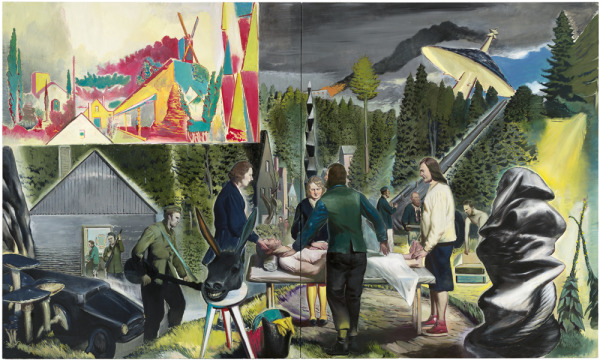
Heillichtung (2014) is a diptych three meters tall and five meters wide. In the upper left hand corner Rauch included a psychedelic rectangular insert visually distinct from the rest of the painting. It depicts a discordant arrangement of houses in vibrant colors. The insert functions as an additive compositional device that contrasts the tenebrous narrative taking place in the rest of the piece. In the rest of the painting elements including the head of a donkey, Brancusi’s Endless Column, what appears to be a UFO, a burning building, a man on a stretcher surrounded by other men and women tending to him, and men in uniform contribute to the sensation of uncertainty of what the narrative means because their relationship to each other is unknown.
Rauch’s work cannot be pegged down to be purely social realism or surrealist despite its surrealist qualities because his paintings come from real and imaginary experiences. He does not aim to shock people or depict sexual fantasy as Surrealist Salvador Dali did. Rauch describes his work as having a vital quality like a creature or animal that can be acknowledged as such but its meaning does not necessitate understanding by the viewer.