Friday, October 16, 2020

The Guggenheim Circular - Home


Artist

Joan Miró

b. 1893, Barcelona; d. 1983, Palma de Mallorca, Spain

Title

The Tilled Field

Date

1923–24

Medium

Oil on canvas

Dimensions

26 x 36 1/2 inches (66 x 92.7 cm)

Credit Line

Solomon R. Guggenheim Museum, New York

Accession

72.2020

Copyright

© 2020 Successió Miró/Artists Rights Society (ARS), New York/ADAGP, Paris


Home is an online exhibition focus on sharing a collection of art that related to home, whether is physical home or homes that artists can relate to. The pandemic forces most of us to stay in places where we define as shelter. When we use Zoom, we are forced to share the most private parts of our lives, identities, so home changes from a private place to a semi-private one. One only shows the part that you want to show to people. Some artists in the show decide to show a moment in their household, some decide to imagine the place considered a home, and some artists decided to show a corner that they think represents the most of their home. 

Some people’s places are big enough to accommodate work from home situations, but most of us cannot afford more space to make into a working office. The boundaries between a workplace and a place to relax have shifted after the pandemic and many people forced to redefine what is a home to them now. With that being said, most of us required to open a certain spot in our home to be shown on the internet or a zoom call, the pandemic also makes us open our privacy in order to continue to live a “normal” life. What we used to call home has changed to life and workspace, The Guggenheim Circular - Home showcases a variety of homes, whether it’s from a physical point of view or with a psychological lens to help us redefine home. 

In “The Tilted Field” by Joan Miró, the artist chose to portray the entire landscape of his home. Inside his home, he includes the animal and trees he loves and cares about. The colors and the lines contrast, and I see day and night in one painting. The different styles show how the artist’s definitions of home, the home represents himself, his belief which he incorporated three flags into his painting. 

"In The Power of Your Care": Examining Autonomy and Disability in Hannah Wilke's "Why Not Sneeze"


Hannah Wilke | Why Not Sneeze (1992) | Available for Sale | Artsy 

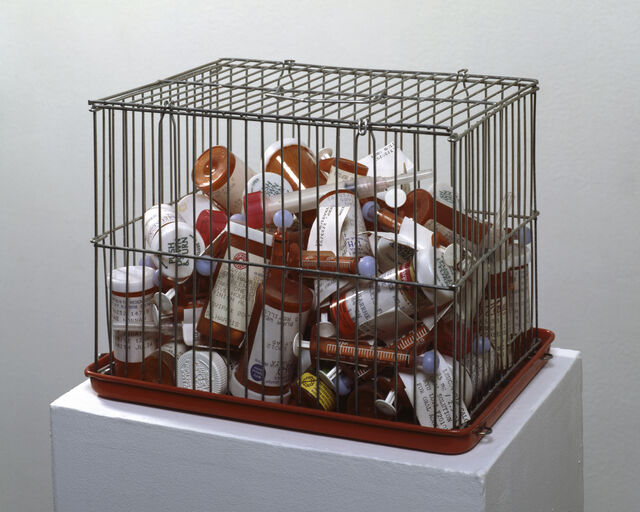
"Why Not Sneeze" Hannah Wilke, 1992.

Wire bird cage, medicine bottles, syringes

7 × 9 × 6 7/8 in
 
 "In the Power of Your Care" is an exhibition put on in 2016 by The 8th Floor examining "health and health care as human rights, and the interdependencies of care in our culture, from personal relationships to systems of care in a policy context."  The exhibition featured many artists whose work addresses illness or disability.

Hannah Wilke's "Why Not Sneeze," is described as a sculptural portrait. Wilke's medical waste, including medicine bottles and syringes, are encapsulated in a found wire birdcage. The title of the work is an allusion to Marcel Duchamp's "Why not Sneeze, Rose Sélavy?," a sculpture using a found wire birdcage that encases marble cubes that resemble sugar cubes. 

The question "Why not sneeze?" begged by Duchamp's original work of art is meant to be a type of rhetorical question. Sneezing is an involuntary bodily function, and so there is no point in asking questions about sneezing, as if a person has any control over whether they sneeze or not. I believe this idea of involuntary bodily functions is seminal to Wilke's work. In her work, the question "Why not sneeze?" serves as a sort of ideological placeholder for any other involuntary bodily function. For people with chronic illnesses or disabilities, some of their bodily functions are outside of their control, but the dominant narrative around disability is that these people have some form of control over their disability, or what their bodies can do. Wilke is saying that she is not in control of her body as much as people would think, and to suggest that she can control these things is as nonsensical as asking someone to control how they sneeze.


Friday, October 9, 2020

The Guggenheim Circular/Time

Zoe Leonard, 1961, 2002–ongoing. Vintage suitcases, for every year of the artist’s life; one suitcase added every year, dimensions variable. Solomon R. Guggenheim Museum, New York, Purchased with funds contributed by the International Director’s Council 2014.119. © Zoe Leonard. Photo: Bill Jacobson

    Time is so much more palpable with the lack of structure in Covid times where days blend together. Days, weeks and months were taken away when we had to quarantine ourselves. Time has been the unit of change in all cultures, regardless of beliefs or economic background. Time can affect everyone and will change everyone's lives, when we started our quarantine we moved from a present to an online world that made everyone restructure their lives.

    In Zoe Leonard’s work we can understand the passage of time with her timeline of her luggage. Fashion has always reflected how society has changed and has evolved, what we think is interesting today might not be tomorrow. This idea of constant change is shown physically in her art exhibition. Each one of us has changed emotionally and our style has changed with it, it's hard to believe what we once used to accept as true and accept the change . Thinking about what I used to find pleasure might not have changed but emotionally I answer differently. Religion for instance, it was introduced to be as chirstianity and I accepted as true growing up but by the pass of time and knowledge gain I have questioned it. I react to the principles that I learn and morals within the Bible but I no longer consider myself christian. 

    In the memories that she had collected in each trip with each bag, Leonard’s time was established by memories and people that changed the artists and her collection shows it with the timeline of luggage. I can relate to the growth in changing perspectives and in the collection this message makes sense together as she is one person and has only modified herself in her evolution. Change is encouraged and shown in the models of bags that have changed but the continuity of blue hues is what let us know that is one person that has evolved, the essence is there and the details changed.


Friday, October 2, 2020

 Exhibntion from “ How Can We Think of Art at a Time Like This? “ 


Photography art by Mouna Karray, the artist get the inspiration during period of constraint, isolation and immobility, he believes the world wil have some change after this crisis.The series “Noir” echoes foucus on the concept of isolation, deprivation of movement and luck of freedom…  People are not allowed to go outside, and the world is disconnect, photography become a way to feel freedom instead of a tool of taking picture.


The white stretch fabric in the photo appears to be healed but restrained, and the outline of the body is looming, adding to the mystery of the photo. The black cable seems to be the only way to the outside world, so when the body is tightly wrapped, there is a One hand still holds it firmly.


At the same time, at this time, he linked creativity and imagination to break the boundaries of the country and new areas of invention. "Nous avons rendez-vous où les océans se rencontrent" This series of photos is a virtual representation of people and things that exist in different spaces. The encounter between people and different cultures and things is extra strange and thought-provoking in this case.


The Guggenheim Circular:Opalka 1965 / 1-∞: by Roman Opalka


Roman Opalka (French/Polish, 1931–2011)

Opalka 1965 / 1-00: detail 2910060-2932295 , 1965

Medium:Acrylic on Canvas

Size:196 x 135 cm. (77.2 x 53.1 in.)


The online exhibition “Time” is from the collection of the Guggenheim Museum. The works in the “Time” show all focus on the relationship between time and life. Especially during this pandemic, people are all waiting for the “time” to solve problems. Such as finish the quarantine and back to home, recover from the virus. In Opalka 1965 / 1-∞: detail 2910060-2932295 by Roman Opalka (1931-2011), an acrylic painting on canvas. In 1965, the artist painted the number one with white paint at the top left hand corner. This work can be considered as a journey the work and Opalka went through together. The end of the work is the end of Opalka’ life. During this 46 years, Opalka used a numerical sequence to fill the canvas. He once said: “My procedure manifests nothing apart from the duration of a lifetime.” This work is a record of Opalka’s life. Time is fluid and people can not touch it. However, Opalka created a way let us to see the passing of  times. Time rely on people to live. Without people, time means nothing. When the artist passed away, the painting of the work concludes. The collection shows the new understandings of how time structures our lives. Artists let people can see the time. Some artists keep on moment and some like Opalka let time leave its stamp.


"BUILDING A BETTER MONUMENT" Exhibition Review


 "Building A Better Monument" is an exhibition curated by Seph Rodney on the website ArtAtTimeLikeThis, an online art institution focusing on arts and artists in the time of crisis such as 2020. As city governments react to protestors by removing the confederate statues during the past summer, one shall wonder what there will be to replace the colonialist icons. “Building A Better Monument” includes 9 artists dedicating their works to represent the marginalized demographics through monuments in the format of architecture, performance, painting, and sculpture. The exhibition utilizes the medium of videos and pictures to showcase the diverse range of works yet still manages to undermine their powerfulness by prioritizing the introduction writing through improvable website layouts. On Joiri Minaya’s page, her series “Containers”, in which she intervenes colonial statues by wrapping them with patterned fabrics, is simply stripped of the sheer impactful visuality due to the small-sized pictures comparing to the banners and texts. It is comforting to see that arts like these are able to engage with audiences in a time that is more relevant than ever, but the effort should not be spared perfecting the viewing experience for the webpage medium that is much more limited than its physical counterpart. 


Friday, September 18, 2020

The Guggenheim Circular Takes on "Time"

The Solomon R. Guggenheim Museum, known for its famous spiraling central gallery, faced some challenges of recent events as other museums, galleries, and institutions. The Guggenheim Circular is the museum’s new online series that reviews themes gaining attention because of the relevance to the COVID-19 pandemic such as time, home, embrace, and community. This platform of the circular presents artworks and resources from the museum’s collection and its previous exhibitions to bring new interpretations and connections to the work. Presented in an easy to follow and accessible format, the Museum has made up for the hiatus in foot traffic up their circular ramps.

Marina Abramović, Cleaning the Mirror #1, 1995. Five-channel color video installation with stacked monitors, with sound, 180 min., 112 x 24 1/2 x 19 inches (284.5 x 62.2 x 48.3 cm) overall

Time is the Circular’s most recent edition, featuring sixteen still images of artworks that relate to the “nature of time” and question time standardization and its fluidity. Included are pieces of varying media like video, photography, objects, and installation images. All of these pieces were presented as images that could be enlarged accompanied with a description. For an exhibition that reflects time so mcuh, the viewer cannot fully embrace the time aspect of certain media like such as Marina Abramovic’s performance Cleaning The Mirror #1, a film duration just shy of 15 hours. The Guggenheim Circular is a great tool for reviewing pieces in the collection, but fully experiencing the artwork requires a physical visit to the museum. The Guggenheim Museum is set to reopen October 3, 2020. The online platform is enough to help us get by, but the full experience is still in the museum.


"How Can We Think of Art at a Time Like This?" Exhibition Review


                                                        LuYang Delusional Mandala (2015)

 “How Can We Think of Art at a Time Like This?” is an ongoing online exhibition which was conceived during the Coronavirus pandemic. Its intention is to challenge its titular question: how can we think of art at a time like this? 2020 has housed a number of historical events aside from the pandemic, such as the BLM movement, a presidential race, and more. The more than 70 artists involved in this project are contemporary thinkers and futuristic challengers whose work resonates with the feeling of “what now?” - a feeling 2020 has instilled in many. 

Lu Yang is one artist whose piece responds to the pandemic. They discuss their struggle with mortality, and how the virus has amplified their fear of death and dying through a series of digital renderings, all which depict their take on the future of Artificial Intelligence. With robots, cyborgs, and so on, this series is intended to reject mortality; Artificial Intelligence can never die, it is immortal and immune to all disease and despair i.e the repercussions of the coronavirus.

 By allowing serious conversation about the reality of today's world for both its artists and its viewers,  “How Can We Think of Art at a Time Like This?” is a place of refuge for those overwhelmed by current events - its vast body of work takes a nosedive into the most important questions of our time and leaves one with a different perspective from which they came.


"How Can we Think of Art at a Time Like This?" Exhibition Review


Sucker: from the Liz Taylor Series, 1994. Acrylic, marbled paper, oxygen mask on paper. 60 x 40 inches. Collection Gert and Liliane Boudry

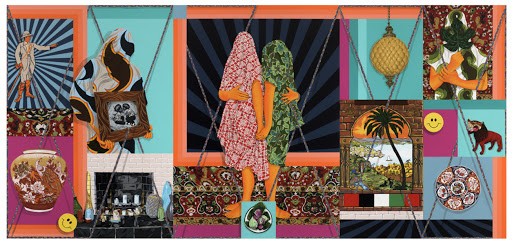
A Distorted Reality is Now A Necessity To Be Free, 2019. Acrylic on canvas. 84 x 108 inches (213 x 457 cm)


   How Can We Think of Art at a Time Like This? is an online exhibition co-curated by Barbara Pollack and Anne Verhallen featuring eighty artists’ interpretations of crisis.  The exhibit seeks to promote a dialogue and sense of community in a time of socially-distancing.  Suffer: From the Liz Taylor Series by Kathe Burkhart takes new meaning in light of today’s coronavirus pandemic in its 60 by 40 inch depiction in acrylic and marbled paper of a woman with a gas mask glued to her face and “Sucker” written across the bottom. Originally a response to the HIV crisis, the work intimates the victimhood of the multitude infected with COVID-19.  A Distorted Reality is Now a Necessity to be Free by Amir H. Fallah speaks to the desire to hide.  The 84 x 108 inch acrylic painting on stretched canvas portrays two figures holding hands while facing opposite directions with covered faces.  Though surrounded by familiar cultural items, of both sentiment and oppression, they are shrouded.  The show is presented using an image-based interface reminiscent of Instagram.  The number of works and varied interpretations invites a response from a wide audience.  However, the amount of images can overwhelm viewers by creating a conversation with too many voices rather than a clear statement.

Thursday, September 17, 2020

The Guggenheim Circular: Paul Ramírez Jonas’s "Another Day"


Paul Ramírez Jonas’s Another Day, 2003, Solomon R. Guggenheim Museum, New York

    The Guggenheim Circular, the Guggenheim’s online exhibition,  features Paul Ramírez Jonas’s Another Day as an addition to its “Time” module. This collection is centered around the fluidity of time that caused by the world’s current pandemic, forcing masses into isolation and dramatically altering routines of daily life. This unpredictability of time is reflected in Jonas’s piece, featuring three television screens that reflect a countdown to sunrise in ninety different cities. This contingency of time is reminiscent of departure times in airport and train stations, and evokes a sense of circularity.  As a part of the mid-pandemic online exhibition, Jonas’s work Another Day, forces the audience to recollect moments of travel in which the wait to depart seemed endless. Now, in a time where most travel is at a halt, we look back on these times where we felt these in actuality short waits were long ones. What was arduous then is an eternity now. The work’s emphasis on geographical difference also alludes to the fact that regions across the globe may be at different stages of recovery but, in the end, we are all waiting for our “sunrise”.

Wednesday, September 16, 2020

The Guggenheim Circular: Tayeba Begum Lipi’s Love Bed

    The Guggenheim Circular’s online exhibit “Home” is a collection of works that explores the domestic space’s varying meanings and endless contradictions. In it, artists address the home as a site of heritage, relationships, and memory. One such work is Love Bed (2012), in which artist Tayeba Begum Lipi used metal razor blades to construct an ersatz bed, a piece of furniture associated with the intimate space of the home, thereby transforming a functional object into a site of charged psychological reality. Through the material, Lipi brings an everyday household object under scrutiny, highlighting our relationship to the objects around us, especially within the home where these objects reside in close proximity to us and signify our roles within the space through memory association. The artist not only illuminates the dynamic between humans and the objects around them, but also addresses the domestic space as a site of human interaction in which objects, such as the bed, become a mediator or site of interaction. By re-imagining the bed as a dangerous object made with razor blades, Lipi references the gendered violence that occurs in domestic spaces, forcing the viewer to confront this violence by giving the experience physical form, an attribute that makes Love Bed so visceral.


Tayeba Begum Lipi, Love Bed (2012), stainless steel, 31 1/4 x 72 3/4 x 87 inches, Solomon R. Guggenheim Museum, New York


Thursday, May 14, 2020

Radical Women - Alice Neel: Viva la Mujer

Alice Neel lived “concurrent[ly] with the 20th century” and the events she lived through, made a great impact on her work. Today, she is regarded as an activist who painted portraits of minority populations and art world elites alike.
Neel’s paintings are loose and expressive but have a certain truthful frankness to them. In the podcast, Molesworth mentioned that the “history of portraiture” is “one riddled by narcissism, flattery, and patronage”. However, Neel’s paintings depart from this as her portraits rarely depicted conventional beauty. 
Alice Neel, Pregnant Woman, 1971
One of the first aspects pointed out about Neel was that she was a mother as well as an artist. Her paintings also feature mothers and pregnant women. In Pregnant Woman, the subject’s expression is of tired acceptance of her situation rather than elatedness. This and the sickly greens of the paint exemplify the more grotesque aspects of motherhood.
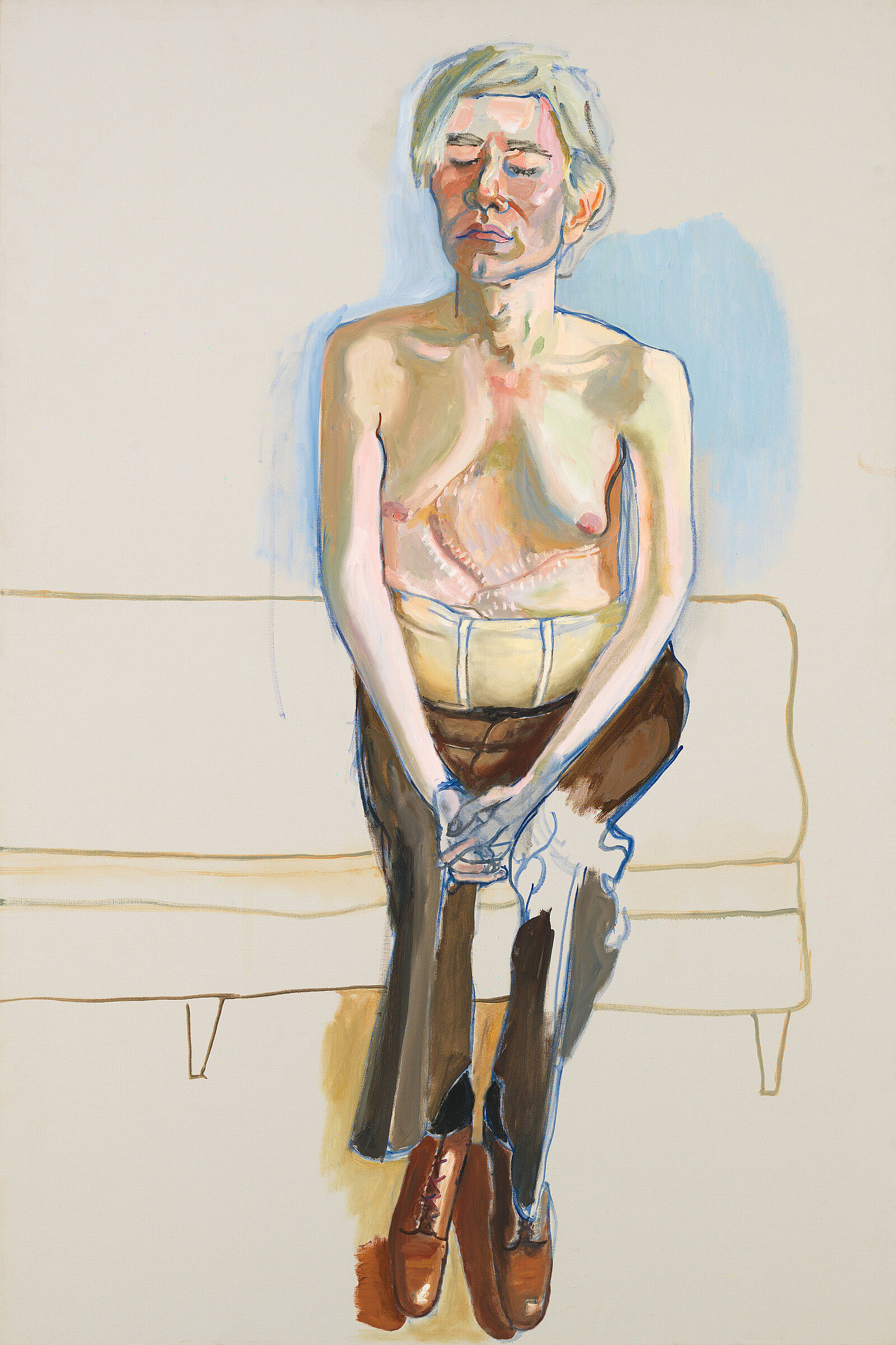
Alice Neel, Andy Warhol, 1970
Before listening to this podcast, I did not know much about Neel. But upon further research, I realized there as one painting I was familiar with, the portrait of Andy Warhol at the Whitney Museum. I always thought this portrait showcased the humanness of Andy Warhol who is a sort of unreachable idol in the art world. His eyes are closed, the scars on his aging chest are exposed and with the soft pastels in the color palette, there is an effect of quietness one would not expect from the explosive career and personality Warhol embodied. 
Alice Neel, Self Portrait, 1980

Neel continued to paint portraits throughout her life and one painting mentioned in the podcast is her Self Portrait in 1980. She is a woman of 80 years of age and that can be seen from her naked sagging flesh and wispy white hair. This portrait epitomizes how unafraid she was of depicting and embracing the imperfections of being human.