Showing posts with label Manhattan. Show all posts

Friday, October 23, 2020

Questioning Healthcare from The 8th Floor: In the Power of Your Care


Presented by The Shelley & Donald Rubin Foundation at The 8th Floor Gallery in 2016, In the Power of Your Care explored the shortcomings, limitations, and political issues surrounding healthcare. The exhibition addresses the identities of those experiencing different forms of health crises such as cancer, HIV, the ban on blood donations from gay and bisexual men, institutionalized care and more. Artists Jo Spence and Terry Denne’s collaboration, Picture of Health: How Do I Begin?, from 1982-83 portrays Spence wrapped in a white sheer cloth with a single ‘X’ over her left breast, marking her future mastectomy. The color photograph reclaims her body from illness. In Arena, a painting by Frank Moore from 1992, the artist depicts the surreal, other-worldly, and circus-like quality. Set within a circular maze-like construction, skeletons of people and animals, doctors, patients, diagrams, spiritual deities and observers. The image connotes a cynical view of medicine in which the patient is at the mercy of the doctors and on display for others. The exhibition drew attention to the experiences of individuals currently or previously going through medical crises, injustices, or life shifts. The exhibition points out the ways healthcare shapes our society and calls for changes in the policies that block us from humane care for all.
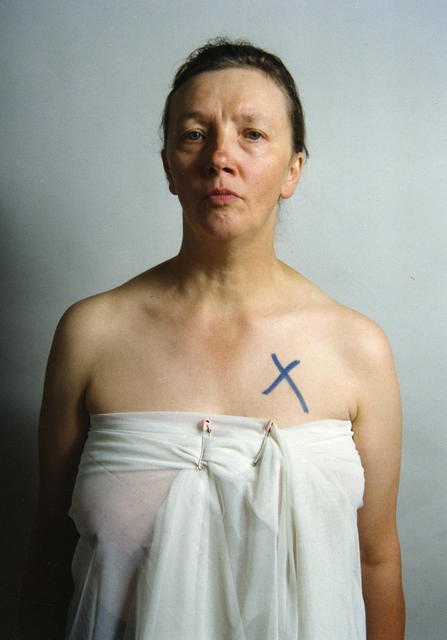
Jo Spence | A Picture of Health: How Do I Begin? (1982-1983) | Artsy

Picture of Health: How Do I Begin? by Jo Spence and Terry Denne. 1982-83. Image courtesy of Artsy.


Arena by Frank Moore. 1992. Oil on canvas. Image courtesy of Artstor. 

Saturday, November 26, 2016

Mythological Time : An animated film by Sun Xun


Sun Xun’s animated film Mythological Time is installed as part of the group show Tales of Our Time, currently on view at the Guggenheim. It is a mesmerizing expression of memory, time and space. Xun, who originally trained as a painter, builds his animations from large-scale paintings in black ink on white paper, and carved woodcuts that create a popped-out three dimensional feel. 
The renderings are sketchy and impressionistic, resembling the style of the early 20th century painters. The whimsical images seem carefully selected to convey underlying symbolic meaning towards a political, historical and cultural context. 

Xun mixes memorable images from his own life, such as the view from a favored childhood fishing hole, and carousel horses, with well-known political images and cultural symbols such as the famous Mao Zedong statue in Shenyang and the totems of the Chinese zodiac.  Enigmatic figures populate the film as well, such as fossils depicted within crystal boxes, with which Xun makes a clever connection to the Chinese coal industry.

Xun does not offer explanations through exposition, but rather lets the scenes flow into one another. Like the scenes, the images move and morph into other forms, giving the animation an unpredictable and interpretable narrative. A layer of black scribbled lines is laid over the scenes behind so that even still scenes have the feeling of constant movement. These images, paired and morphed together, take the mind on a journey through space and time. Like an exquisite corpse, the pairing of opposites provides an opportunity for the mind to make new and unexpected connections.   

The film's ever changing form becomes a metamorphosis that speaks to the way memory can bend our perception, and that this change can be unpredictable, sometimes deceiving, and difficult to interpret. Watching Mythologica Time felt like slipping through the cracks between reality and memory, like a journey through the space in-between, which seems to be the place Xun is most interested in exploring.