Showing posts with label painting. Show all posts

Friday, October 23, 2020

Questioning Healthcare from The 8th Floor: In the Power of Your Care


Presented by The Shelley & Donald Rubin Foundation at The 8th Floor Gallery in 2016, In the Power of Your Care explored the shortcomings, limitations, and political issues surrounding healthcare. The exhibition addresses the identities of those experiencing different forms of health crises such as cancer, HIV, the ban on blood donations from gay and bisexual men, institutionalized care and more. Artists Jo Spence and Terry Denne’s collaboration, Picture of Health: How Do I Begin?, from 1982-83 portrays Spence wrapped in a white sheer cloth with a single ‘X’ over her left breast, marking her future mastectomy. The color photograph reclaims her body from illness. In Arena, a painting by Frank Moore from 1992, the artist depicts the surreal, other-worldly, and circus-like quality. Set within a circular maze-like construction, skeletons of people and animals, doctors, patients, diagrams, spiritual deities and observers. The image connotes a cynical view of medicine in which the patient is at the mercy of the doctors and on display for others. The exhibition drew attention to the experiences of individuals currently or previously going through medical crises, injustices, or life shifts. The exhibition points out the ways healthcare shapes our society and calls for changes in the policies that block us from humane care for all.
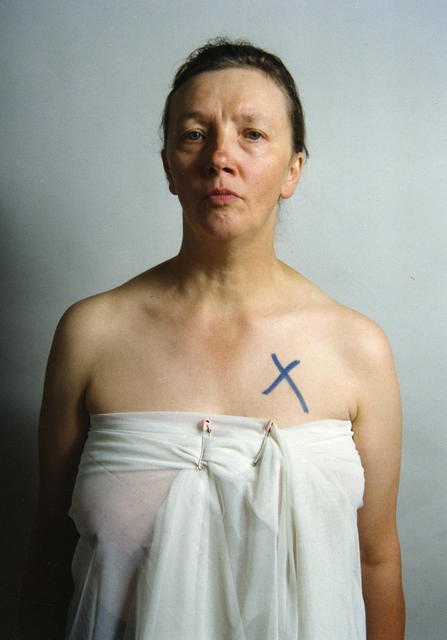
Jo Spence | A Picture of Health: How Do I Begin? (1982-1983) | Artsy

Picture of Health: How Do I Begin? by Jo Spence and Terry Denne. 1982-83. Image courtesy of Artsy.


Arena by Frank Moore. 1992. Oil on canvas. Image courtesy of Artstor. 

Friday, September 30, 2016

OSGEMEOS Transforms Lehman Maupin Gallery into an Urban Art Space

Brazilian twin brothers Gustavo and Otavio Pandolfo, collaborating under the name OSGEMEOS, have transformed the Lehmann Maupin Gallery space into an immersive interior landscape in their new show Silence of the Music.
 OSGEMEOS's show illustrates the evolution of urban street culture, in paintings depicting boom-box-toting-b-boys dancing on cardboard mats, a mystical music-cart made of junkyard scraps, interactive turntables with gramophone horns, and a child's lullaby mobile. The exhibit diminishes the traditional physical separation between art and viewer. Every surface of the gallery has been transformed, including the floors and ceilings.  Bright colors, glitter, and sequins create an enthusiastic celebration of street music and visual culture. Depicting the evolution of street music through the lens of visual art, the show illuminates how music and art in urban communities are inextricably bound to one another; that to comprehend their unique history, one must examine them in tandem. The irony of bringing graffiti art into the private gallery space, initiates a discourse about art hierarchies established by the institutionalized art community, but this discourse does not take away from the celebratory emotion expressed by the work. Thus, OSGEMEOS brilliantly creates an exhibition that is to be both thoughtfully considered and sensually enjoyed. 
  
Every surface of the gallery has been transformed, including the floors and ceilings. Bright colors, glitter, and sequins create an enthusiastic celebration of street music and visual culture. Depicting the evolution of street music through the lens of visual art, the show illuminates how music and art in urban communities are inextricably bound to one another; that to comprehend their unique history, one must examine them in tandem. The irony of bringing graffiti art into the private gallery space, initiates a discourse about art hierarchies established by the institutionalized art community, but this discourse does not take away from the celebratory emotion expressed by the work. Thus, OSGEMEOS brilliantly creates an exhibition that is to be both thoughtfully considered and sensually enjoyed.