Tuesday, April 22, 2014

Heidi Bucher at The Swiss Instititue


Viewing Heidi Bucher’s explorations of materiality, space and the body for the first time brought about the feeling that the work could not be any more comfortable within the lineage of seventies Postminialism, but I haven’t seen her work in any exhibitions or books on the subject. It turns out that until this exhibition presented by Swiss Institute her work had not been presented in a U.S. institution since her series Bodyshells exhibited at the Los Angeles County Museum of Art in 1972.
 The Bodyshells, represented in the SI exhibit by way of issues of a 1969 German edition of Harper’s Bazaar, are large, body-swallowing wearable sculptures that seem to transform their occupants into plush, minimalist-aesthetic clams and barnacles. My comparison might seem an attempt to poke fun at the high fashion aesthetics of the past, but the documentary film piece Body Shells, Venice Beach (1972), makes the crustacean imagery reading seem definitive. Presented nearby, in the Swiss Institute’s basement, the film documents the body sculptures casually milling the beach, human heads and feet poking from orifices, and then retreating into the form of sculpture object.  The costumes, perhaps phallic or yonic in form, become oversized manufactured crustaceans planted on the seashore. The series, done in collaboration with Bucher’s then-husband Carl Bucher, highlight a lightness and spirit of play that isn’t nearly as apparent in, what is presented as, her central body of work. 

The “Raumhaut” (room skins), which Bucher began after moving back to Switzerland in the mid-seventies, fill the main space of the Swiss Institute. The works, latex and fabric layered casts of interiors and architectural elements, exude a ghostly and fleshy indexical materiality that lands somewhere between Eva Hesse's aesthetic of latex biomorphic surfaces and the content of Gordon Matta-Clark's architectural ruins. 
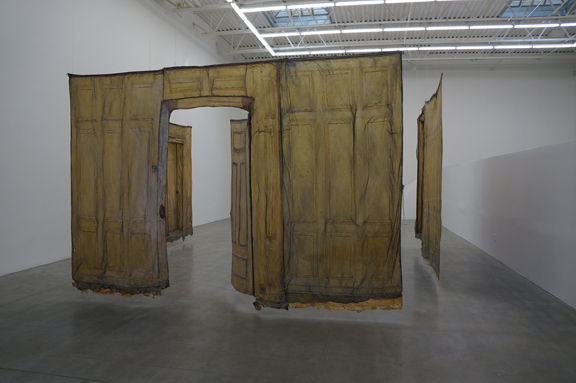
Untitled (Herrenzimmer), undated, latex, cotton, 102 1/4 x 71 x 7 1/2 in. 

The first of these molds, Untitled (Herrenzimer) (1977-1979), hangs in the center of the exhibition space’s lower platform in the manner that now makes viewers think of Do Ho-Suh’s fabric architectures. Molded from the master bedroom’s of Bucher’s parent’s home and installed to recreate three walls of the space, including the droopy cast of an open door, the installation grants visitors an entrance into nostalgia that seeps from the walls. Untitled (Herrenzimer)’s indexical nature seems to assume an added weight and ghostly ethereality with Bocher's personal reference as the wrinkled and sagging walls turn what was originally architecture into a body. 

The other notable mold hangs from the wall with a different sense of grandiosity than Untitled (Herrenzimer). The monumental 1987 cast Grande Albergo Brissago (Eingangsport) replicates, or rather memorializes, an ornate hotel entryway with mold-green columns and classical detailing. The cast, once a wall itself, seeps downs from its support into giant puddles, and what might have once been details of the a lavish décor are lost in the folds. The peeled layers seem to take with them a biographical surface quality from their models, a certain aspect of their liveliness that coats and obscures the surface of interiors over time like dust, but with a certain pathetic attempt at emulating their original. 
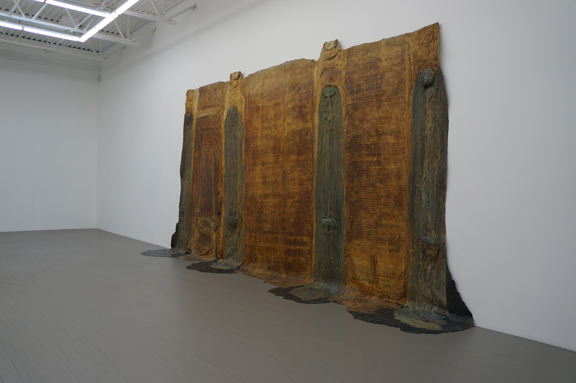
 Bucher16


As with Body Shells, the room skins are put into a significantly new perspective with the insight of the films presented in the Swiss Institute’s basement. Raume sind hullen, sind Haute (Rooms are surroundings, are skins) (1981) is a thirty-two minute film showing the process behind the “Raumhaut.”  It reveals the playfulness with which Bucher approached her work. She slides between the freshly dried cast and walls to pull them apart and on to her self, leaving the room wearing the walls like her Bodyshells.  This disparity between object that exudes a process art ethos and actual documented process complicates the work but hopefully more recognition and exhibitions will follow and clarify Bucher’s practice and art.

Wednesday, April 2, 2014

Emily Jacir's "Ex-libris" at Alexander and Bonin Gallery


Alexander and Bonin features work by the Palestinian artist Emily Jacir, whose work concerns issues of historical narratives of freedom and exile. Ex-libris consists of digital c-prints of numerous sizes taken from a number of pages in Palestinian books linked to former owners.  In 1948, Israeli authorities looted about thirty thousand books from Palestinian homes, institutions, and libraries that are now kept in the Jewish National and University Library in West Jerusalem.  After many visits, Jacir photographed a number of pages with her cell phone, documenting small personal traces within the books of owner’s names, scribbles, stamps and other marginalia. Jacir personally photographed specific segments of the books in search of identifying information of the owner’s names, bookstores, and individuals that requested to view these books. Within that library, six thousand of these books were categorized under “A.P.” (Abandoned Property).  Meaning, the library is voluntarily giving up all rights, titles, or claims to the books, which then rightfully belongs to the owners. If this is the case, Jacir’s work still poses a number of unanswered questions concerning the placement of these books and their significance from the other thirty thousand books located in the library’s general collection. The artist definitely has a deep connection to the physicality of the books, yet her experience is only momentary. In the end, she is left with a photograph that does not exactly have the same sentimental value as possessing the books. 

            By translating the connection between the photograph and book, Jacir took into consideration all formal aspects of presentation. The photographs vary in size and were printed onto Plexiglas and dibond, causing a shiny surface quality. In contrast to the raw materiality of the books, the reflective surface eliminates personal traces and ownership attached, which suggests disconnection. She assembles the photographs onto shelves encompassing the gallery walls. In doing this, Jacir is mimicking the arrangement of books stacked onto library shelves. As a whole, Jacir does not only tackle issues of looting of the Palestinians’ belongings, but also touches on issues about restitution and repatriation of Palestinians.  Today, the debate of returning the books to their collective property is not as simple as it seems. It is possible to return some books to their rightful owners, but this investigation needs further analysis.  Jacir’s focus on the marginalia and annotations inside of the books is the key component in finding further information on provenance, and it also allows the viewer to relate and empathize as it brings a human touch to the conflict.

Tuesday, April 1, 2014

Richard Mosse's alluring distress: "The Enclave" at Jack Shainman Gallery

The Enclave

Jack Shainman Gallery in Chelsea has for years been showing the work of Irish photographer and cinematographer Richard Mosse. But after last summer the task of presenting the work of the New York based artist in the context of a commercial gallery became somehow more complicated. Representing Ireland in its national pavilion at the 55th Venice Biannale, Moose created a shocking and alluring 6 channel video installation. So the task at hand for his New York gallerist was to transfer the celebrated artwork from the site of a non profit mega-exhibition into the 20th street Shainman location.
As a result, the show in Chelsea was divided in two sections -both of them aesthetically marvelous. In the first part the visitor encounters large scale photographic prints of the landscapes that Mosse was documenting during his expedition in the jungles of Congo, while in the second part, viewers witnessed the incredible experience that the Enclave was for the visitors of the Biennale.
Entering the realm of research practices, Moose and his artistic entourage approached the documentation of a horrific conflict through the lens of art, creating a powerful argument: By employing unconventional videography techniques, the artist visually transforms the terrain, and as his manipulated imagery blends with an intense soundtrack, it manages to facilitate a discourse about how the so called first world regards the tragedy of an African civil war. The artist uses an outdated military film that was used for detecting camouflaged enemy soldiers, and as a result he creates an aesthetically powerful rendition of documenting a series of grotesque events and everyday life during the war. By masterfully editing the footage within his prism-like space, Mosse creates a fractured narrative that escalates to a point of emotional distress. Beauty and horror dance hand in hand in this experience, while we witness a story that seems real and unreal, happening in a place that even if we know that exists, seems fictional. The Enclave is a documentation of another place, a parallel reality that is far away from the western modern model of life of safety and security. It is a perfect metaphor regarding our approach towards the situation that the human experience is in the struggling continent.


Thursday, March 27, 2014

“Ritual and Reality” by Yishay Garbasz

In Japanese cartoons, the typical scene of street view around home includes small houses standing along a clean narrow road, green trees growing and a cat running across a wall. This scene appears so constantly that numerous audience’s visual imagination of home have been effected, which includes me.


At first glance, Yishay Garbasz’s installation in Ronald Feldman Gallery presents this familiar scene which is warm. Then a cold desolation struck me-- although the physical environment is complete, certain essential elements are absent: no one is walking on the street, bicycles are lying along the side of road and a traffic light is blinking on yellow. The title-- “Fukushima Nuclear Exclusion” tells why: a tsunami that hit a nuclear power station in Fukushima three years ago leading to a disastrous nuclear leak. People living around the accident fled, leaving behind abandoned towns.


Mass media didn’t follow up the aftermath of this deserted area, but Garbasz went there, recorded the scenes and reappeared the abandoned streets in a straight forward way by combining documentary videos, audios and photos. Local houses, clean roads and vehicles on the screens highlight a sad contradictory: the previous vibrant of this area versus the dead emptiness at this moment. Whatever the reasons were for this event, whether it was economical, political, or an act of nature, viewers’ fundamental emotion as humans are challenged: how to face the desolation of lost?

On the screens, as time pass, the environment is being taken back by nature; maybe in time the pain of people will also fade away.

Wednesday, March 12, 2014

Caterpillar Logic II


Peter Buggenhout’s two monolith sculptures appear in the white cube of Gladstone Gallery like remnants of ruins. The masses stand several feet higher than its viewers and are covered in a thick layer of black dust like some readymade or artifact untouched for decades.It is difficult to discern what is underneath. One of the sculptures takes up several feet towards the center of the gallery while the other leans against the wall taking up a comparable amount of space. Layers of worn sheet metal, corrugated metal, rods, bars and other construction supports are put together seemingly haphazardly into these abstract forms. Walking around the mass at the center of the gallery what initially appeared to be a pile of detritus is revealed to be constructed and hollow; it's opening featuring one large component, possibly the corner of an enclosure. Its pair also features the effect of a partial room torn in half and supported just foot or two above the ground by the scraps of metal that create the sculpture. The exhibition’s title Caterpillar Logic II is the first semblance of intention to their design but it is unclear how this relates. This could be a hint to the possible origin of the pieces of these constructions, seemingly discarded from our modern era, and the aura of entropy that resonates from the works.

Peter Buggenhout, Caterpillar Logic II
The two installations, titled The Blind leading the Blind #66 and The Blind leading the Blind #67, are the latest in Bubbenhout’s series of the same name, which began in 2008. The title's reference to Pieter Brugel’s genre painting inserts another ambiguous commentary that is either didactic or apathetic. The whole of Bubbenhout’s work seems to anchor along this question of ambiguity. The works are not quite identifiable; they seem to reject any origin.


Peter Buggenhout, Caterpillar Logic II
As the viewer spends time with the work, identifies its parts and attempts to build a logic it seems that the work might be a sort of Smithsonian Non-Site but any affirmation is rejected to the viewer. The only information a viewer can ascertain is that they are viewing some construction of debris, of the unwanted, that it’s coming from somewhere and that it has been forming for a while 

Doug Wheeler at David Zwirner 
February-March 2014


     Museums and galleries are finding surprising ways to combat dwindling attendance.  Because of the convenience of imagery granted us by the internet it is difficult to remember that most art is sensory, inaccessible through a screen.
     It seems that the art world is responding by staging events that can only be seen in person.  This new breed of art event can often be distinguished from the happenings of ages past by the sheer amount of hype surrounding them.  For example, New York City residents and tourists waited in line all day for MoMA's Rain Room without any guarantee that they would make it inside. 
     Retrospectives of James Turrell, Robert Irwin, and Yayoi Kusama offered sensory immersion that dragged art audiences out of their armchairs and into the museums.  We are even seeing the blatant exploitation of fame to increase art viewership with Jay Z's performance of Picasso Baby at Pace Gallery or Tilda Swinton sleeping at the MoMA.
     Upon entering Doug Wheeler's recent installation at David Zwirner Gallery one is plunged into complete disorientation.  The room has been turned into a featureless dome of colored light.  The light creeps up the walls from the perimeter, the only thing upon which the eye can rest.  This horizon-less landscape is hypnotically ambiguous, like an endless tundra.  As my eyes swept forward and back, trying to take hold of something.  I had the sensation that I might be leaning oddly forward but couldn't be sure.  Struggling to find what was vertical I turned toward the chasm-like opening through which I entered.  With this in view, the room became a sort of inverted igloo.  Suddenly I could orient myself and find my way out. 
     All this has been to say that Wheeler's installation seems to be another addition to a larger trend in art.  The luminous cavern created in Zwirner's West 20th street gallery is truly an experience.  An experience which begins with a polite request that one take a seat and wait, continues to the soft white booties viewers are asked to don before entering and ends with the full body immersion into illusion and light.