Wednesday, December 2, 2015

Dia Foundation in Soho- The Earth Room (revised)


  The Earth Room is an interior earth sculpture made by Walter De Maria in 1977,presenting in the same spot at Soho for over 30 years. This is not the first Earth Room Walter has made, but it is the only one maintained by the Dia Foundation.


  The sculpture takes up about 3600 square feet of floor space, 22 inch earth, with a weight 280000 lbs. The whole room is filled evenly with soil but has an amazing clean and tidy white wall. The space has been partitioned in up and down, like a ground and the sky. Visitors are not allowed to go through the room and stand on it. People can only stand outside and look. There are some small rooms inside the big room. Sometime you feel like there is no end to the room. When you come closer to the Earth Room itself, you can feel the air and the moisture differences compare to the outside space. The temperature is a lot lower in the room, like natural air conditioning in the hot summer. Outside the building, busy people walking by, and time is passing. However, inside the building, I feel time is frozen at the moment in 1977, the time when the sculpture had been made. 

The location of Soho, Manhattan can specially emphasize the contrast of busy life and still moment. Besides, it is sarcastic to see the artist trying to save a beautiful nature of land inside a building in the jam-packed New York City.

"Alberto Burri: The Trauma of Painting" at the Guggenheim Museum


Alberto Burri, born in 1915 in the Italian city Citta di Castello, is one of the most important Italian artists after World War II. This major retrospective exhibition at Guggenheim Museum is first one in 35 years in the United States and takes place one hundred years after he was born. It is a comprehensive review of this important artist's life and career. Visitors follow spine route of the Guggenheim to explore more than one hundred works, including many that have never been exhibited outside of Italy. The hallway circling up looks like a white ribbon extending to the infinite which provides an excellent space for Burri’s exhibition.


Burri utilized mundane materials such as sand, rock, mud, old cloth, burnt wood, rusted iron, and burnt plastic sheets. Burri transforms these cheap materials to express emotional trauma as in abstract and modernist work. He also takes the advantage of materials to blur the line between the painting and sculpture. He emphasizes the power of substances and his works often made metaphors to skin and wounds with stitching, riveting, soldering, and stapling of his paintings.


In addition to paintings, there is a special exhibition room, which presents his large-scale outdoor sculptures - Grande Cretto through medium of a documentary film. This is a work commemorating his hometown. In 1968, this city was completely destroyed by earthquake. Burri created a 8,000 square meter of concrete works in 1985. After more than 30 years preparing the work, he finally completed. The film leads audiences around the work as if they really would walk into it. As with many of his paintings, this work is full of complex textures and sharp lines, which appears to brand the face of the earth with scars post-earthquake and has the same form and spirit of his other works.


Along the Guggenheim exhibition abstract space, which is a perfect path for viewers to experience the art path of Burri’ various aesthetics from texture, form and color to his mentality and psychological progression.

Tuesday, December 1, 2015

Urban Martyrs and Latter-Day Santos / Museo del Barrio (revised)


When you first enter Rodríguez Calero’s “Urban Martyrs and Latter-Day Santos” exhibit at Museo del Barrio, you are greeted with a large block of text printed on the wall explaining the main focus of the show. You are told that Calero’s large-scale religiously inspired collages “move us spiritually. The disturb and challenge us…” The language continues like this, dictating audiences’ reaction to the works in a tone that seems more applicable for an article written well after the work has been critically received, rather than accompanying the works in one of their first exhibitions. In fact, to someone who did not grow up with the experiences Calero did as a catholic minority, the language is somewhat alienating; such viewers will likely respond differently to her images of models-turned-saints. The descriptions of individual works feel better suited to a later publication than to in-gallery text that directly accompanying the original works; rather than adding to the collages, the texts leave out answers to questions the viewer may have (such as who the models are, or the significance of the patterns Calero uses) and eliminate opportunities for free response and discussion.

However, the second part of Calero’s show stands in striking contrast to the first. Smaller scale collages, unaccompanied by the didactic texts or overt symbolism of the religious works, create an environment that allows for curiosity and discovery. In these works, Calero not only pushes the method of collage farther than in her large-scale works by transforming her sources more drastically in these pieces, but explores the face, the human figure, the movement of the body, and even the way viewers perceive gender. Some works have a dialogue with the history of art, creating cubist faces or using antique clippings as sources, while others twist figures into sometimes-androgynous, sometimes-hermaphroditic forms that question what it means to be male or female. These works speak much more to a wide audience and do not suffer from the heavy-handedness of the religious collages. Overall, the exhibit is worth visiting to see Calero’s smaller collage works and the risks she takes in them.

Monday, November 30, 2015

Alberto Burri Retrospective at The Guggenheim

Composizione (Composition), 1953
A visit to an exhibition at the Guggenheim is always highly curated experience; that is, the main atrium (with its famous spiral walkway) provides a specific context in which the viewer can observe the art. Throughout the years, the Guggenheim has been criticized for being an awkward and unorthodox space to present artwork; yet, it is in fact a perfect location for the Alberto Burri retrospective.

The act of ascending the spiral walkway (despite architect Frank Lloyd Wright’s wishes that visitors descend from the top floor) imbues the show with a rhythmic narrative quality. Burri’s legacy as a master of materiality experimentation and a pioneer of modern abstract expressionism is best showcased chronologically, a presentation that hearkens back to storytelling traditions from antiquity. The space itself allows for a celebration of the artist’s evolution over time, as well as his own story, which adds a singular quality to his approach to visual expression.

Burri’s work presents a thorough exploration of materiality, and dissects and reassembles the language of dada, surrealism, and collage. His materials run the gamut from organic to processed and further reflect the retrospective’s narrative quality. We can see a sequential progression from one material to the next; as one “experiment” ends a new one begins. Often times, Burri’s choice in material coincides with a dynamic point in Italy’s history. For example, his manipulation of hard metals through welding came about during an economic boom, during which steel production skyrocketed. By contrast, Burri’s older work breathes life into banal imagery with his Sacchi, in which he creates tortured collages of humble and familiar textiles such as linen and burlap, which allude to Italy’s ravaged social landscape during and after the Second World War.


In a way, Burri’s retrospective at the Guggenheim respects ancient traditions of storytelling, and allows us to appreciate the art for its craft and its context. The rawness and humanity of his work, the way in which materials can be both beautiful and crude, become the spirit that unites the artist to his surroundings.

Saturday, November 21, 2015

Susan Cianciolo at MoMA PS1: Greater New York (revised)

The fashion industry aligns with perfection, a prescription, rules, which place limitations on design. At MoMA PS1’s fourth Greater New York exhibition, fashion designer and artist Susan Cianciolo subverts these expectations.

In a quiet and somberly lit room, a line of mix-matched mannequins stand atop of wooden panels, exhibiting pieces of Susan Cianciolo’s brand RUN. Hand-rendered with Crayola markers: eyes, lips, and shoes accessorize the haptic designs. On the middle platform Reconstructed vintage Carolina Herrera with patchwork applique featuring hand silkscreened fabric (1990) features woven ribbon collages, patches developed from tablecloths, and smeared thick paint strokes of gold and pink embellish the manipulated nude and gold flecked dress. The work is handcrafted and purposefully unfinished, undermining the fashion industry favor for perfectionism in design. Susan Cianciolo’s visceral approach made her a leader in the 1990s deconstruction movement, against the mainstream focus on trends and the new.

Looping on repeat: collaged clips of Cianciolo’s films and runway shows are projected on the opposite wall. A mundane old TV set sits alongside streaming clips of models walking down the runway. Unlike what fashion films are thought to be: a high quality advertisement, pursing lips in high heels—status, Cianciolo’s films are not focused on the clothing at all, but on a narrative, where characters just happen to be wearing her pieces or “costumes.” The lo-fi image quality separate Cianciolo from the futuristic HD expectations of the fashion industry; nostalgia over idealization.
            The third wall contains books that Cianciolo used to document her thoughts, research, and plans for developing collections. The books are not blank sketchbooks but found mediums, already containing text and images Cianciolo builds, tapes, scans, and draws over. Just like her clothing, Cianciolo builds into, overlaps and collages into that which already exists.
            Today, Cianciolo’s design philosophy inspires the contemporary market, resurfacing in brands like Eckhaus Latta, and through her role as a professor at Pratt Institute: encouraging students not be afraid to be themselves.

Friday, November 20, 2015

Kiosk at MoMA PS1's Greater New York

In it’s fourth 5-year roundup, MoMA PS1 presents Greater New York with a special focus on the nostalgia for the past. Of the 157 exhibiting artists, there is a wife and husband duo, Alisa Grifo and Marco ter Haar Romeny with a collection that particularly traverses the line between the local-artist reminiscence for the past and the sting of expensive real-estate reality in the present.

Among the overwhelming landscape of over 400 paintings, sculptures, photographs, garments, and surprisingly few new media installations, is their quirky display, the KIOSK Archive of about 3,000 small objects. 


Neighboring a gallery of life size figuration, KIOSK is configured in a rectangular room with a fair amount of square-footage stacked and filled to the brim with 1ft by 1ft modular plastic squares. The cubes house individual curiosities, from Kazoo trumpets, to copper cheese graters, kinder creme and pocket Japanese carpenter-knives. 


MoMA PS1’s curation of a curated collection of cheap and not-so-cheap international novelties arise a fascination with consumption culture. Since the items are in fact for sale, it leads me to think there might be a slight indulgence with a consumerist appetite. 


Though, there is something clever to hosting a consignment shop in a show that seeks to subdue today’s urban financial challenges by relishing in New York’s past. Kiosk was once a local store in Soho founded in 2005, until an expensive lease seized it’s closing in 2010. A decade ago, one could peruse the shop’s textured surfaces and tangibly marvel the curiosities facilitated by a knowledgeable clerk. Now, the Kiosk is solely an online market, where one must browse an archive of square images behind a screen and clicks for paragraphs of informational text. The exhibition of Kiosk is representative of an all too familiar gentrified-fate of artist goods going to the transient digital.

Revised: Richard Pousette-Dart: 1930s at The Drawing Center

Richard Pousette-Dart was most recognized as a important member of the New York School of painting and also the youngest member of first generation of abstract expressionists. Before the 1940’s, his paintings and drawings were marked by thick black contour lines and primitive themes, such as figures.  The Drawing Center exhibition is the first in-depth consideration of Pousette-Dart’s drawings from 1930’s.  During this period, the artist made sculptures and did drawings and paintings also.  These drawings explore a lot of his concerns about sculpture, line, shape and form. These simple elements, along with vivid colors are prominent in these works. Some may say they enjoy the pure visual pleasure, some may say the drawings look like a mix of Picasso and Matisse, some may feel the work is somehow linguistic and find it extremely boring.    


"Agony" is a drawing made with graphite, ink on paper, it is about 18 by 15 inches. A twisted solid figure form is in the center of the work; the shapes are full and sharp. The deep red background is powerful, with a heavy emotion also expressed by the figure.

"Untitled" (Figue-495) is a drawing made with India ink and gouache on paper. It is about 17 by 14 inches.  It is a weird drawing; The figure is in a distorted dancing pose. The pose looks unnatural and the proportion of the body is untrue.

2015-11-04-pousette
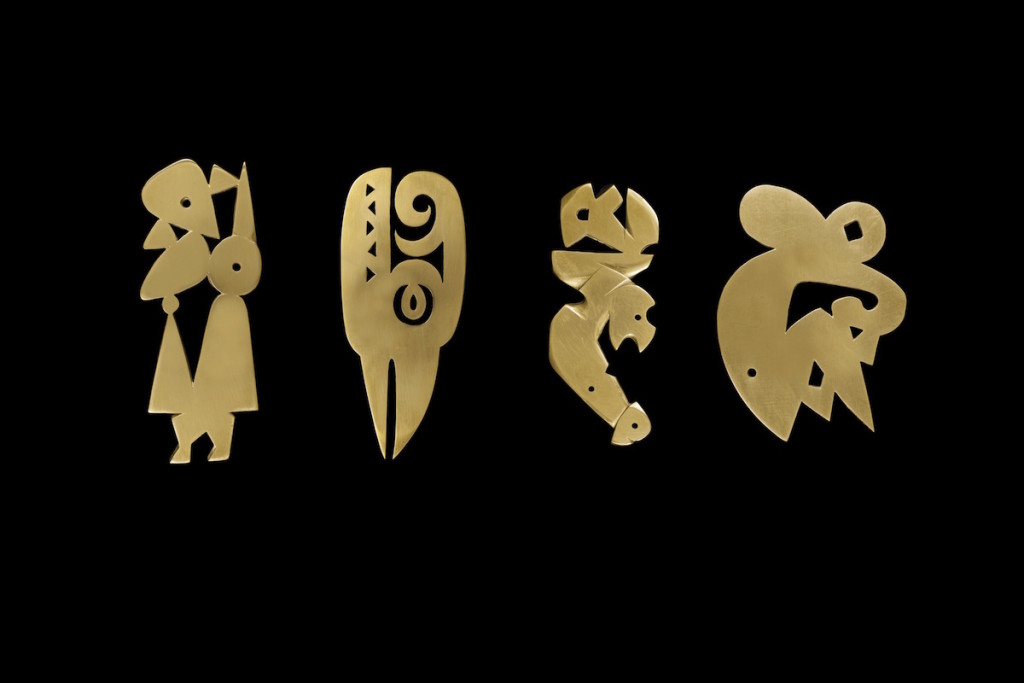
There are also small brass sculptures on display. They are hand-cut, pendant-like and mostly about 5 to 8 inches. The artist noted that he based his designs on forms in nature and organic symbols that people variously seem to attach. These little sculptures are functionless but adorable. I wish I can see theses sculptures as paper-weights.