Thursday, October 4, 2012

TERESITA FERNANDEZ AT LEHMANN MAUPIN


pastedGraphic.pdf

Teresita Fernández’s exhibition at Lehmann Maupin is named after the 19th century tactile military code “Night Writing” - the predecessor of Braille enabling soldiers to communicate quietly at night. This exhibition continues her long-lasting interest in perception and nature, while initiating an exploration of the boundless possibilities of language - something that never fails to transform itself and create opportunities for communication, even in complete darkness and silence. A large-scale installation, made of hundreds of color polycarbonate tubes hanging in the middle of a two-story space, probably representing a sunset sky, it entices the viewer to look up once entering into the gallery. Also on view are a series of perforated prints, varying in size and composition while sharing a common subject matter of the night sky.  A narrow palette of black, purplish red and white is adopted throughout the prints and the installation, adding a sense of cohesion to the exhibition.

The group of prints, appearing somewhat repetitive at the first sight, reveal a greater depth of meaning upon closer examination. Each work is perforated with mysterious patterns of dots - the Braille translation of its title - spreading all over the composition. Representing Braille letters, these tiny holes exemplify a way of communicating without visual or auditory sense, a language to be “heard” through finger tips. While from the visual aspect, these white dots arranged against images of night sky are reminiscent of constellations, a “language” seen in nature through which much can be understood by human beings. As written by Fernández in her book, “Like a vast billboard, the night sky has always been read and scanned for revelation, direction and guidance.” 


Wednesday, October 3, 2012

Dave Cole at DODGE Gallery


Photo credit: DODGE Gallery

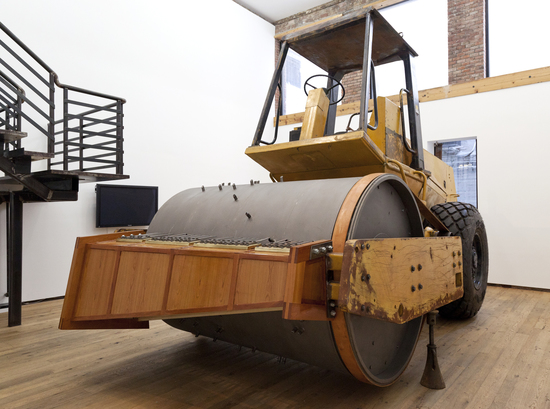
If it takes you a few moments to grasp the tune of that song coming from Dave Cole’s Music Box, don’t fret.  But don’t be scared away by it, either.  As the centerpiece of Cole’s latest solo exhibition, the Music Box attracts those seeking a spectacle.  The enormous steamroller clanking and clambering on the lower floor of the two-story gallery is quite thrilling, its large mechanical drum-turned-music-box-disc powered by a mere three-pronged power cord plugged into the floor at its side, as it hammers through a rendition of “The Star Spangled Banner.”

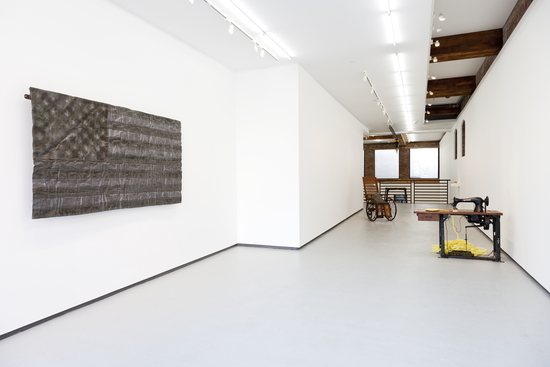
In addition to the show’s main attraction, bits of Americana are scattered throughout the gallery, including Singer, an industrial sewing machine made in New Jersey in 1920.  Questions about national identity are evoked with works such as Belt Plate, a “U.S.” belt buckle cast from melted bullets, and American Flag (Lead), a representation of our flag sewn in heavy industrial lead.  These works impress upon the viewer a certain nostalgia that can only be explained by a lack of genuine craftsmanship in today’s consumer-driven society.  The objects, as well as the materials from which they are constructed, demonstrate the ways in which industrial manufacturing can intersect with home-spun craftsmanship to resonate with the collective memory of the public.  Dave Cole effectively alters these well-known objects in an attempt to appeal to a cultural heritage which may have been difficult to recall at first, but becomes increasingly familiar.  You know that you recognized that song, it just took you longer than you would like to admit.

Photo credit: DODGE Gallery
Photo credit: Sam Cornwall


Friday, September 21, 2012

MICHAEL RAKOWITZ "The Breakup"


When viewing Michael Rakowitz’ “The Breakup” at Lombard Freid Projects Gallery, one is presented with a multi-sensory exhibit.  A calm, recorded voice of a man comes quietly from a radio, narrating a documentary and occasionally dropping familiar names: Paul, John, Ringo, George, and is interspersed with short musical clips from various catchy tunes by the Beatles.   It’s impossible not to be drawn towards the glass-top tables, with cursive handwriting scrawled on the surface with permanent marker- the text hovering ghostlike over an orderly and historic display of Arabic/Palestinian maps, magazines, record covers, Israeli currency, and Beatles memorabilia, reminiscent of a collection of pinned butterflies caught forever in a tragic moment. 

While the connections between the Middle East and the Beatles breakup are not at first easily understood, one begins to piece together the similarities between a Palestinian attempt to unite their nations and the Beatles’ brief reunion.  Paintings referencing the color palate of the album cover “Sargent Pepper’s Lonely Heart’s Club Band” line the walls alongside collages combining images of the Beatles with flags and symbols of the Middle East, leading the viewer towards a dark room where a video clip plays the only “reunited” Beatles’ performance, followed by a video of a Palestinian band playing Beatles’ songs with arabic instruments.

Offering a reserved, “historical” collection, “The Breakup” is an unexpected juxtaposition of two disparate “failures” of collaboration.

SHARON HAYES: THERE’S SO MUCH I WANT TO SAY TO YOU


Viewers are welcomed by a 100-foot long white curtain; and after going around it, they discover several stages and altars with signs and objects of propaganda: the central focus of the show. The artist creates a path based on sound routes and different points of attention, where different monologues are spoken out loud and podiums and microphones are guides for the audience. Hayes uses old album covers to highlight historical issues in American politics during the 70’s. The installation is contextualized in the ultimate political rebellion associated with the Occupy movement, and it has its roots in the queer right struggle that occurred in public spaces during that time. Ms. Hayes looks at this period from a critical distance.


The artist creates stages, scenarios and stands to congregate, which can be viewed as an architecture of empowerment and rebellion. However, despite the contemporary design fair or pavilion aesthetic, Ms. Hayes doesn’t create a space for appropriation or the participation; she underestimates the viewer, even though she gives us tools for a new 'revolution’.  Viewers have to behave only as spectators and contemplate in the company of the museum guards. One cannot approach the stages, touch or photograph the installation, and finally one is left to wonder: is it possible to create a revolution inside a museum? In the end, the show must be understood as a call to re-envision new forms of association, groupings and language for mankind: a universal call to congregate; pure idealism that is absolutely necessary in these days.

Thursday, September 20, 2012

JAMES WELLING: Overflow at David Zwirner


Overflow showcases three bodies of work that explore the impact of painting on both the content and process of James Welling’s photographic practice. Wyeth depicts the home, studio, and subjects of Andrew Wyeth, whose work influenced Welling early in his career. Welling digitally sampled color from those images for Fluid Dynamics, which consists of large abstract prints created by exposing wet photo paper to light. Finally, the smaller black and white photograms of the series Frolic Architecture were created by painting onto mylar, then creating photographic contact prints from the paintings.

Wyeth includes Glass House, an almost monochromatic image of two frost-covered windows in the corner of a white room, the paint on their frames peeling. This image is particularly stark, but the other photos in Wyeth have a similar sense of emptiness; the series works to depict something that is no longer there. In contrast, the stunning purple and green swirls of FD1M burst off of the wall, and the bright energy throughout Fluid Dynamics belies the subdued source of the color. Though quieter, the black and white images of Frolic Architecture take this transformation even further, giving painterly form a life of its own. Welling takes a thread of influence from Wyeth and spins it into entirely new creations, giving us insight into his personal artistic development while sketching a new paradigm of the pictorial.


JANET CARDIFF & GEORGE BURES MILLER: THE MURDER OF CROWS

 
Stepping out of the late-summer sun into Janet Cardiff and George Bures’ sound installation, The Murder of Crows, is shock to your senses. Beneath the single light source is a gramophone, over which Cardiff’s voice reciting dreams is heard, with seats surrounding it in a semicircle. The dark, cavernous space at Park Avenue Armory feels infinite as 89 speakers pull you in. Cardiff’s voice recounts three dream sequences that are interspersed with unnerving soundscapes until tension is finally released by a sweet lullaby.  Like sitting around a story teller, the lit space is a designated safe area while sounds crescendo to frightening intensity and break with clarity around the darkened drill hall.

Cardiff creates a loose narrative as the dreams lead into soundscapes that drive the story forward by powerfully pushing through to the next scene. Visitors experience the violent machinal clanging of a post-industrial chaos following Cardiff’s description of an unknown, flowing blood source and the beautiful operatic chorus singing about a lost leg after a description of the disembodied limb found in an abandoned beach house. The clarity and sensual quality of the sounds heighten unease as the visitor becomes totally absorbed. Exploring the darkened drill hall is welcomed but you cannot know what lurks. Each step away from Cardiff’s voice takes your further into her nightmare.

Sunday, September 16, 2012

ELAD LASSRY: UNTITLED (PRESENCE) @ THE KITCHEN


If you come across Elad Lassry’s work and leave a little perplexed, do not fear- it is the curiosity and imagination in ambivalence that he strives for. Untitled (Presence) is an installation consisting of film, photography and sculpture, discussing how framing devices influence analysis of a work. By oscillating perspectives through altered architecture, scattered patterns in images (hollywood portraits, still lives, abstract forms) and shifts from photography to sculpture, Lassry focuses less on the content of each individual image but the potential relationships created by arrangement. Photographs line the walls ranging from still lives to portraits. A wave-like sculpture in the center of the space can be viewed through a wall or more closely after walking around the wall. At first, there seems to be no relation between the varying imagery in the photographs and with the sculpture in the space. However, Lassry creates an open discussion model away from didacticism and linear thought so the viewer can make relationships between the objects for themselves. A conclusion of the work does not have to be of a singular path of thought, but of forking paths with conclusive potentials. It is not only the content in each image that makes the piece whole,  but the relationships with what is surrounding the image. Lassry leaves  the “meaning” of art  to the perceptive audience- a welcomed freedom.

Thursday, April 26, 2012

Peter Shelton: powerhousefrenchtablenecklaces at Sperone Westwater


Peter Shelton sculptures were produced from 1989 to present. Each sculpture is abstract but also combines more literal imagery. Elemental combinations of water and bronze are vibrant in each piece. The kinetic sculptures fill the room with sounds of gentle splashing water. The calm and somber sculptures have a connection to the human body by use of hollow vessels and slow running water.
Peter Shelton titled his show powerhousefrenchtablenecklaces. This obscure title links some of the materials used in the show bronze, copper, French table, necklaces, random items, and water. The cover of the shows card has an upside down skull with water dripping out of the nose hole. This sets the tone for the ritual experience the viewer is about to embark on. One begins to roam slowly throughout the installation. Each large sculpture, warm in color and sound, invite the viewer to come closer and investigate each piece. In powerhousefrenchtablenecklaces one of the sculptures has water running all over necklaces. After exploring each piece you begin to focus in on how many moments each sculpture has. The house pictured above hangs with a creepy slight tilt and copper tubes running in and out of each floor, nook, and cranny inside the house. As you peer in you can see each floor has water running down the stairs filling up the cavity of each empty space. The viewer feels like a giant peeking in on a shrunken flooded home. The connection between water and the empty cavities is close to human bodily fluids and the hollow yet complex vessel the human body. Each sculpture has so many different angels in which to view each assemblage. 

Shelton uses many different sculptures that represent vessels throughout the entire installation.  (Pagodawindowskull, 1993. Bronze, water, copper, pump, and wood, 68 x 16 x 16 in. 600 (172.7 x 40.6 x 40.6 cm.) This piece has water dripping from upside down architecture onto the skull. With the water dripping all over the bronze and copper it begins to have the texture of skin. The soft glistening copper is reminiscent of the dermis. Using a skull is tricky in fine art and it can be a cliché, but how Peter Shelton combines the water and material is removed from cheesy skull art.  Shelton sculptures do not have a gothic or grotesque tone. The materials balance each other out with the hard outer surface laced with running water. The bronze shine sharp hints of blues and iron oxide tones while the water curls over the top half of the skull. The assemblage with kinetic movement and sound gently touches the senses. Shelton's installation powerhousefrenchtablenecklaces is full of sculptures that link the vessel and the human body. The connection between body and fluid is shown throughout the installation space. Once you enter the other room two large sculptures appear opposite in texture and color. 

These large-scale fiberglass sculptures are intense. They look like gigantic body organs with many different holes. The sculptures welcome viewers to approach and investigate the meaning. The connection between vessel and human body become clear in this space. You can peer in each hole, even the awkwardly placed holes where the viewer has to kneel down to see. These pieces take some participation to fully embrace the connection between vessel and body. These pieces in conjunction with the bronze pieces in the other room are a reference of body and fluids. The sculptures also appear to be soft sculptures but in reality are fiberglass. The contrast of hard and soft is like the human body. 

Peter Shelton: powerhousefrenchtablenecklaces is a strong installation that utilizes kinetic sculpture. The combination of vessel, fluid, architecture, and human body links use with the material items we surround ourselves with. Home and body in conjunction with vessel and water are important themes in Shelton’s installation. Water is an important element that is vital to our survival on earth.

MOMA's Print/Out (revised)


Print/Out: 20 Years in Print is the Museum of Modern Art's highly anticipated survey of a medium that is versatile, rooted in history, and appears to have no limits. Chief Curator of Prints and Illustrated Books Christophe Cherix displays works by more than forty artists in a salon style show with prints literally installed from floor to ceiling. If stunning the viewer with hundreds of prints ranging in size, content, and execution is what Cherix set out to do, then surely this mission was accomplished.

A curator is faced with the task of creating a common denominator amongst included works, a theme or idea that the viewer must interpret. In Print/Out the differences, ambidexterity, and individualism of the numerous printmaking methods are what bind the show. Many of the works are steeped in conceptual ideas such as Martin Kippenberger's Content on Tour which is an appropriation of an appropriation. He uses printmaking as a means to an end, sometimes cutting and slicing his own prints to make paintings.  Others refer to and question the history of the medium, inventing new techniques for age-old processes such as Jacob Samuels creation of the first portable aquatint box (1996).

Printmaking began as a mechanized way to produce multiples, an idea that lends itself to portability and affordability, but Cherix has made it clear that editions are no longer a requirement for this medium. In fact only two editions, in entirety, are included in this show, Kara Walker's Safety Curtain (1999) and Damien Hirst's The Last Supper (1999).  Walker's series highlights her preoccupation with paper cut-out style grotesque yet humorous imagery focusing on slavery. Hirst's is a pop-art series of large colored silkscreens of fake food labels. Both artists created a suite of images, editions comprised of many different prints. All of the intended images from the series are represented at MOMA, but are easy to miss for they are spread out amongst the hundreds of works on the entire sixth floor.

With such a mishmash of prints, and with the large amount of them on display, smaller intimate works are easy to miss, but are worth noting. For example Julie Mehretu's Untitled (2004) from the  Landscape Allegories series. This etching is an exploration of line and shape, referencing both nature and mathematics. It resembles a topographic map overlaid with imagery derived from nature. It is a traditional print, using multiple layers and transparent inks to achieve a broad range of color and tone, and is one of an edition of seven.  The print is technically stunning and seems fragile and airy.

The more classic methods of printmaking are juxtaposed with installations of groups such as Superflex, who held a particpatory workshop where the viewer can construct a hanging lamp with pre-printed photographs. General Idea's group project, Magic Bullet (1992), is also a memorable non-traditional take on reproducibilty and distribution. Hundreds of silver pill-shaped balloons imprinted with their logo fill the ceiling' skylight space, but only as long as the helium's lifespan. Viewers are invited to take home any of the piece's fallen soldiers, an interesting comment on the intended portability of the print.

While many of the historically rooted prints included in the show seem to be overpowered by bigger installations, and even the gallery walls themselves which were covered in Benday dots, Cherix's decision to display the many modes of printmaking in a salon style exhibit with prints covering nearly every inch of the exhibition shows that there is not one correct or preferred way to make a print these days. Equal opportunity is given to all of the modes of making. The show examines the many possibilities of a medium that is often pigeonholed as outdated and uninventive. By having a medium-specific themed show, the viewer leaves not thinking of an inner dialogue about what it all means but with a visual cornucopia of images and a greater idea of the unlimited possibilities that can be found under the umbrella of printmaking.


Wednesday, April 25, 2012

Diego Rivera: Murals for the Museum of Modern Art

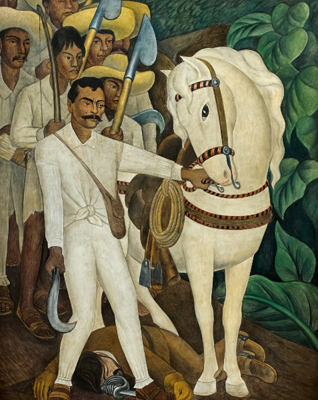
Agrarian Leader Zapata (1931)

The Museum of Modern Art revisits its own 1931 single-artist retrospective with Diego Rivera: Murals for the Museum of Modern Art. The original show opened with five frescos that Diego executed on site specifically for the museum. Of these five initial frescos, four, such as Agrarian Leader Zapata, were based on small sections of frescos in Mexico that cemented Rivera’s international reputation as a renowned muralist. The fifth fresco, The Uprising, aesthetically bears resemblance to the group, but is not based on any part of Rivera’s previous murals. After the 1931 show opened, Rivera continued to develop three additional frescos, all original and based on New York City’s architecture and economic issues of class division and industrialization.

All of these frescos were executed on portable walls in an attempt to solve the problem of showing frescos to an audience wider than those who could see them on the buildings or structures upon which they were painted. Americans, most of whom would not otherwise have seen Diego's frescos, could get a glimpse of what his work looked like. Unfortunately, a small section of a mural is not the same as the entire thing. Rivera failed to convey his fresco’s beauty and meaning in these fractional recreations. Then, as now, his immense talent and ability were not perceived by those who based their assessments on these works and nothing more.

Balcony of Cortez Palace in Cuernavaca, Mexico
It is disappointing that curator Leah Dickerman chose to repeat the flaws of the 1931 show by excluding any meaningful information about the larger murals that Indian Warrior, Sugar Cane, Agrarian Leader Zappata and Liberation of the Peon were based on. It could have been especially valuable to include, among all the other information on the walls, small pictures showing the detailed murals that each of those came from. Within that context, the aesthetic value and technical innovation of the portable Rivera panels would finally have become apparent.  

The strength of this show is in its didactic approach to Rivera’s techniques. MOMA takes good advantage of the materials available to them from recent conservation work on the series, such as x-rays of the wall supporting the Agrarian Leader Zappata fresco. The inclusion of information on fresco techniques, such as giornata, and two of Rivera’s large cartoons help connect the technical details to the frescos on display. Dickerman even includes a list of the pigments Rivera used (though neglects to elaborate on binders, which given the other technical details included feels like an oversight).
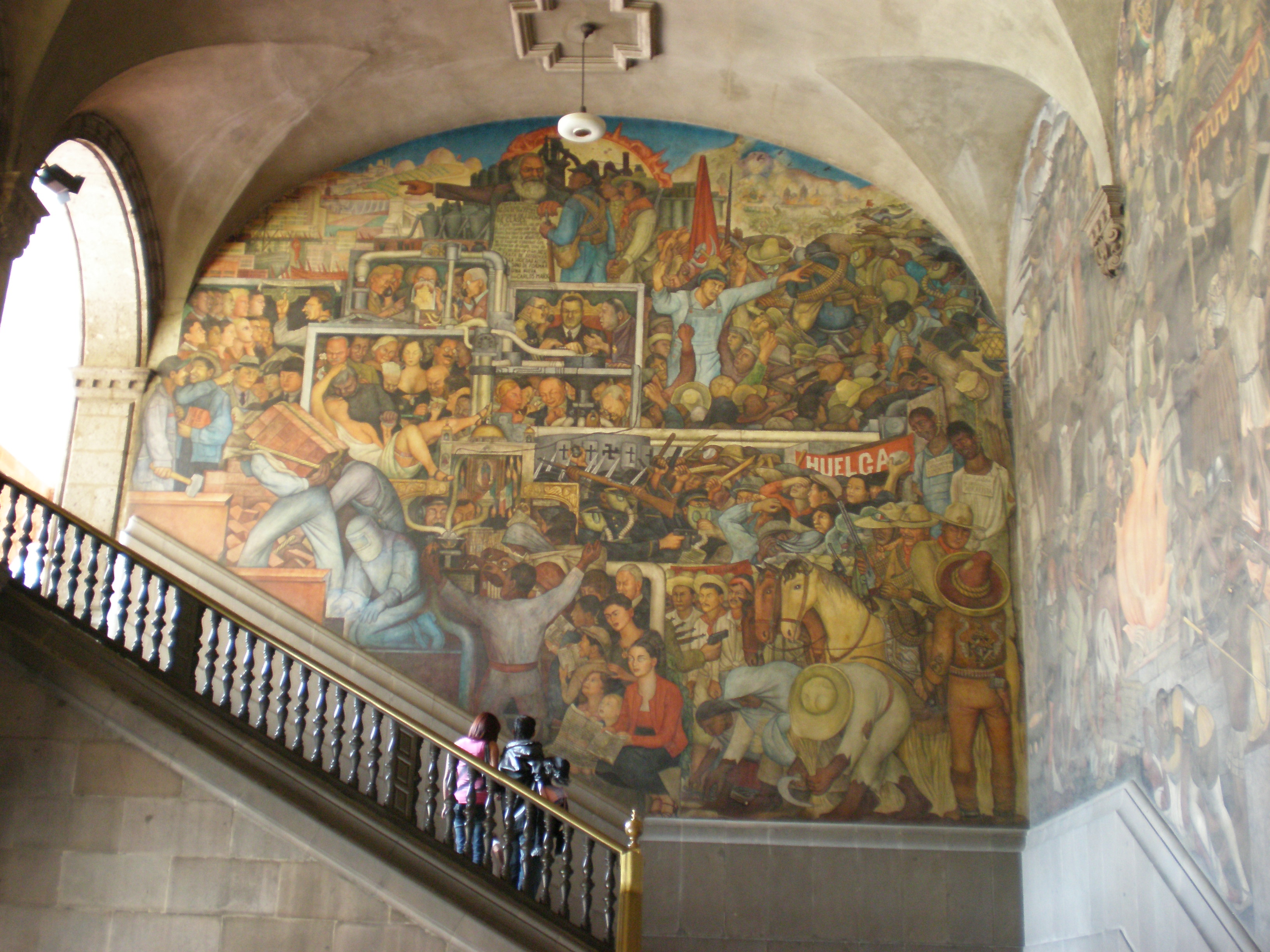
Rivera's mural at The National Palace in Mexico City


Unfortunately, the rest of the show is full of even more missed opportunities and distractions. An example of the latter is the sketches from Rivera’s trip to Russia. Though Rivera met Alfred Barr while on this trip, there is no clear reason why the curator chose to include the sketches from Diego’s trip to Russia, other than to fill space on the wall. The sketches and information shown about the Rockefeller mural is an example of the former, an incredible opportunity not taken by the curator. The way this part of the exhibit is presented, Diego is portrayed as cluelessly spiteful of his American patron or petty in his oblique political statements. In reality Diego had a convoluted relationship with America- this played out dramatically around the Rockefeller mural project. He was rarely anti-America, but he was always anti-imperialism. Nor were his political interests a surprise to the Rockefellers or anyone at MOMA. He was simply such a famous, popular and important artist at the time that he was given commissions at MOMA and Rockefeller Center in spite of his well-known radical political positions.  

Rivera’s unique blend of traditional European iconography with less familiar Mesoamerican iconography and stylistic references is charged and designed to signify his work’s broader meaning. The biggest loss from MOMA’s decontextualization of Rivera and the fresco’s in this show is that it dilutes meaning to such an extent that viewers are bored instead of challenged.

Friday, April 20, 2012

"March Forth" by Henry Taylor at UNTITLED


Henry Taylor, a Los Angeles-based African American artist lauded for his colorful acrylic portraits, has a gift of capturing the nuanced moods of his sitters despite using a bare, non-naturalistic painting style. March Forth, his new solo exhibition, is a foray from these figurative paintings into drawing, sculpture, and installation. Inspired by Taylor’s recent trip to Ethiopia, the gallery has been transformed into a low-lit abyss complete with a dirt floor, a taxidermied hyena, and a reconstructed hut of found objects. Taylor’s search for self-expression with new media regrettably feels like a stereotypical African rendering.

The major portrait included in the show is Taylor’s looping home video, presumably created during his trip, projected on the wall above the gallery’s entryway.  His muffled speech into the camera draws our focus to the image of himself as sitter. The sun gleaming behind his left shoulder showers rays across his unclothed body, which fluctuates between discernible and silhouetted due to his enthusiastic movements. Flanking the seating area below the video are walls covered sparingly with partly erased outlined figures and ambiguous text, including a series of letters that metamorphose from the shape of a “U” to that of a “Y” accompanied by the parenthetical “This is not a Y,” to an upside down pitchfork, the eyes of an outlined figure, and finally the shape of a hook. The fact that these transformative images neighbor his introductory self-portrayal sets the stage for the show as Taylor’s efforts to push his art in a new direction.

One of the large-scale works in March Forth is a black hanging sculpture that spans the gallery’s rear wall.  The twelve-foot long untitled piece consists of plastic bottles, detergent containers, and gas canisters nailed to a plywood support spray-painted black. Taylor undoubtedly recognizes their resemblance to traditional African masks, and he accumulates the containers into a collage of varying shapes so that faces of numerous dimensions pop out. This concept is hardly new, conjuring the painted jerrican masks by contemporary African artist Romuald Hazoume. Yet the two artists differ in their treatment of the containers; Hazoume employs uniformity in his assemblage while Taylor abolishes it. The latter’s approach is spontaneous, subtly applying order to a haphazard collection of bottles that might have once been scattered across his studio floor.

Bidon Armé by Romuald Hazoumé, 2004
The centerpiece of the show is Taylor’s reconstructed Ethiopian hut taking up the central space of the gallery. Made up of found and collected objects, the hut is a hodgepodge of brooms and other cleaning tools, a rolled up rug, wooden wheels, ladders, beer bottles and walking sticks for the blind. The openness of the structure welcomes the viewer in for a turn around its interior, and inside are piles of dirt that appear placed equidistantly apart. At its back sits a television playing the video interview of an Ethiopian boy, a Denny’s box sitting atop as if signifying a westernized influence. The hut appears to be an attempt at calming or systematizing a chaotic assortment, but falls short of intelligibly communicating any greater purpose. The materials do not seem to be placed schematically aside from the goal of allowing the hut to securely stand. Taylor has been known to use found objects like cigarette packs and cereal boxes as surfaces for his paintings, but the theme in this context—dirty and lacking a framework for deeper contemplation—reads as a clichéd characterization of Africa.

In March Forth, Henry Taylor’s exploration into sculpture and installation is the focus of the show, but too many stereotypical elements—the dirt, the hyena, the hut—give the show a banality and drown out the profundity behind these new creations. For a figurative painter with such a knack for capturing the idiosyncrasies of his subjects and the larger cultural implications they represent, these qualities are not portrayed through this show.

Alejandra Prieto's Invisible Dust at Y Gallery


As evident in Richard Serra’s work with lead, Robert Smithson’s arrangement of salts and Dan Flavin’s infatuation with fluorescents, humble materials are quite capable of conveying strong ideas. At her first New York solo show, Alejandra Prieto is changing the perception of coal. In Invisible Dust at Y Gallery, the artist uses just four works to prove the versatility of her signature material and to make an even greater argument for its significance as a cultural artifact.
For a show dedicated to coal, it is only fitting that the gallery space is below street level. Like a miner at an unfamiliar site, one feels the urge to duck upon entry, relaxing only as the stairs and antechamber give way to a cavernous room not seen from above ground.  It is here that each of Prieto’s four works gets a wall of its own.  
The first work to catch the eye is Concave Coal Mirror set against the far wall. Spanning six feet in diameter, the work’s unsettling effect is not derived from its imposing presence, but rather its surface. Though coal has a reflective quality, the rough and rubbed textures create a mixture of matte and gloss finishes, making a full reflection impossible. As the surface fails to disappear in the eye of the viewer, he or she is fully aware that they are looking at, not into a mirror. What seems like a novel invention on Prieto’s part is instead a reintroduction of an ancient technique, as coal was used to produce mirrors in pre-Columbian societies. 
Set opposite the mirror, and continuing the Mesoamerican motif, is Ornamental Dust (Chita), a coal dust print on black silk. The fabric illustrates a repeating scene of jaguars and parrots in contrasting patterns. The illustration is styled after the animal imagery found in temples, as if the piece were nothing more than a wall rubbing. A second coal dust print on black silk, titled Ornamental Dust (Laberinto), rests on another wall. It features a more contemporary geometric pattern that would be equally at home on a high-end scarf, or alongside the Chita print in a Mayan-themed gift shop. 
Alejandra Prieto - Cloud on Coal Screen
Cloud on Coal Screen
Prieto switches mediums with the exhibition's most interesting piece – Cloud on Coal Screen, a video projection displayed on a slab of coal. The titular cloud is made of coal dust, and like time-lapsed satellite footage of an oil spill, the viewer watches the inky blob metastasize across the glassy blue surface. 
With this video, Prieto reminds the audience of the destructive force that goes into coal extraction. One does not have to think hard to recall the Copiapó mining accident of 2010 (an occurrence that came just one year after Prieto began showing her work with coal). Thirty-three Chilean miners were trapped underground for over two months. Plumes of dust and smoke similar to the projection’s were certain to have erupted there. As a Chilean who locally sources her materials, Prieto likely has working knowledge of the human toll inherent in mining this commodity.
In Invisible Dust, Prieto makes a compelling case for the reconsideration of coal as an art material and the reevaluation of socioeconomic relationships between the haves and have nots. Standing in the intersection of all four works, one is aware of Prieto’s deft handling of coal across multiple media as well as her optimization of the limited space, staying well clear of the material’s saturation point. From the same vantage point, the tension between labor and indulgence is unmistakable. A civilization’s lifestyle faces off with a superficial representation of itself, while a raw material parries with a commercial good. Coal’s sooty texture supersedes the luster of the luxury items, blackening the silks, masking the mirror and flooding the projection, subtly shaming the viewer into questioning whether his or her purchases are worth more than the wellbeing of the working class.